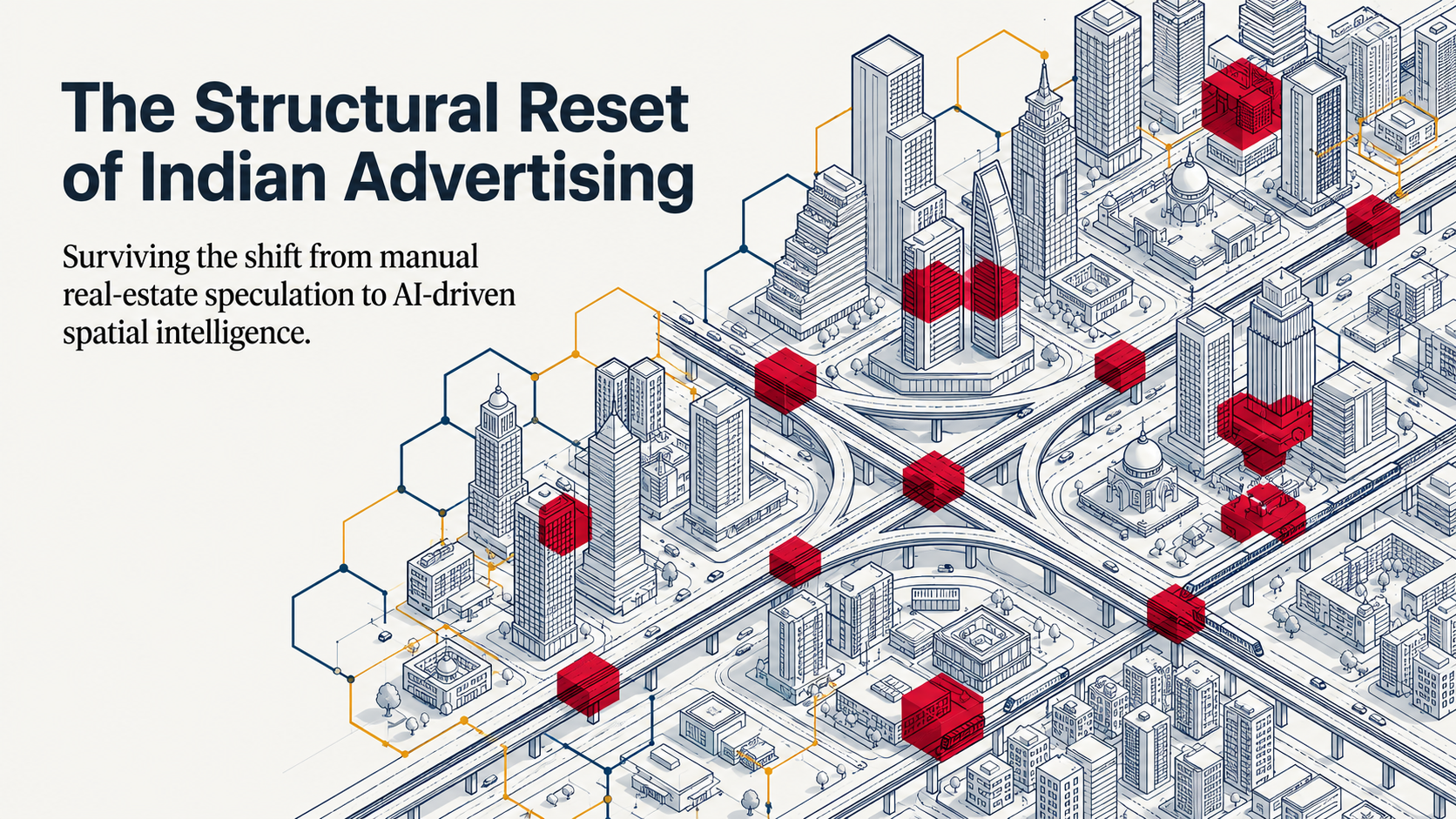
An AI powered OOH advertising platform India represents the first major structural correction for a medium that has historically operated on nothing more than relationships and guesswork. For decades, outdoor advertising remained the "wild west" of the media mix, where budgets were allocated based on which vendor had the best sites or the closest relationship with an agency. By 2026, the arrival of decision intelligence systems has finally introduced a standard of auditability and comparability that matches the digital advertising world.
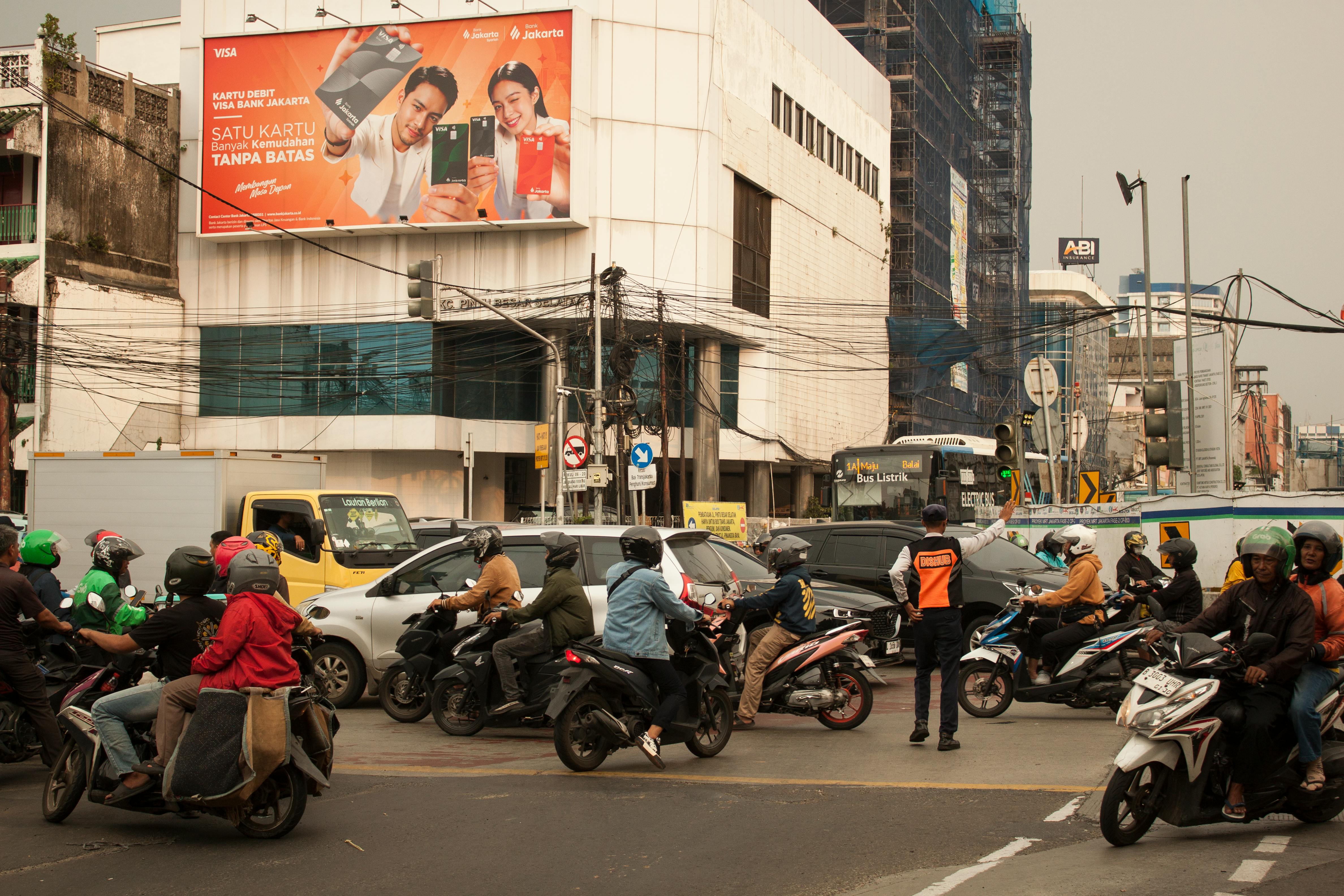
The Indian advertising market reached a staggering valuation of over ₹1,11,000 crore in 2025, and within this massive spend, out-of-home media stands as the only traditional format that grew in absolute rupee terms. While legacy mediums like print and television contracted as audiences shifted to mobile screens, physical presence in our cities became more valuable, not less. Brands now understand that while you can skip a YouTube pre-roll, you cannot skip a forty-foot hoarding while stuck in traffic on the Bandra-Kurla Complex connector in Mumbai.
The urgency for this technology in 2026 is driven by a massive infrastructure boom, with the Indian government opening six kilometers of new metro track every single month. This expansion is creating thousands of new advertising touchpoints in transit hubs and premium corridors that simply did not exist two years ago. For a brand manager today, the challenge is no longer finding space; it is justifying why one particular location is structurally better for their specific audience than ten others.
The architecture of spatial intelligence and the hexagonal demand model
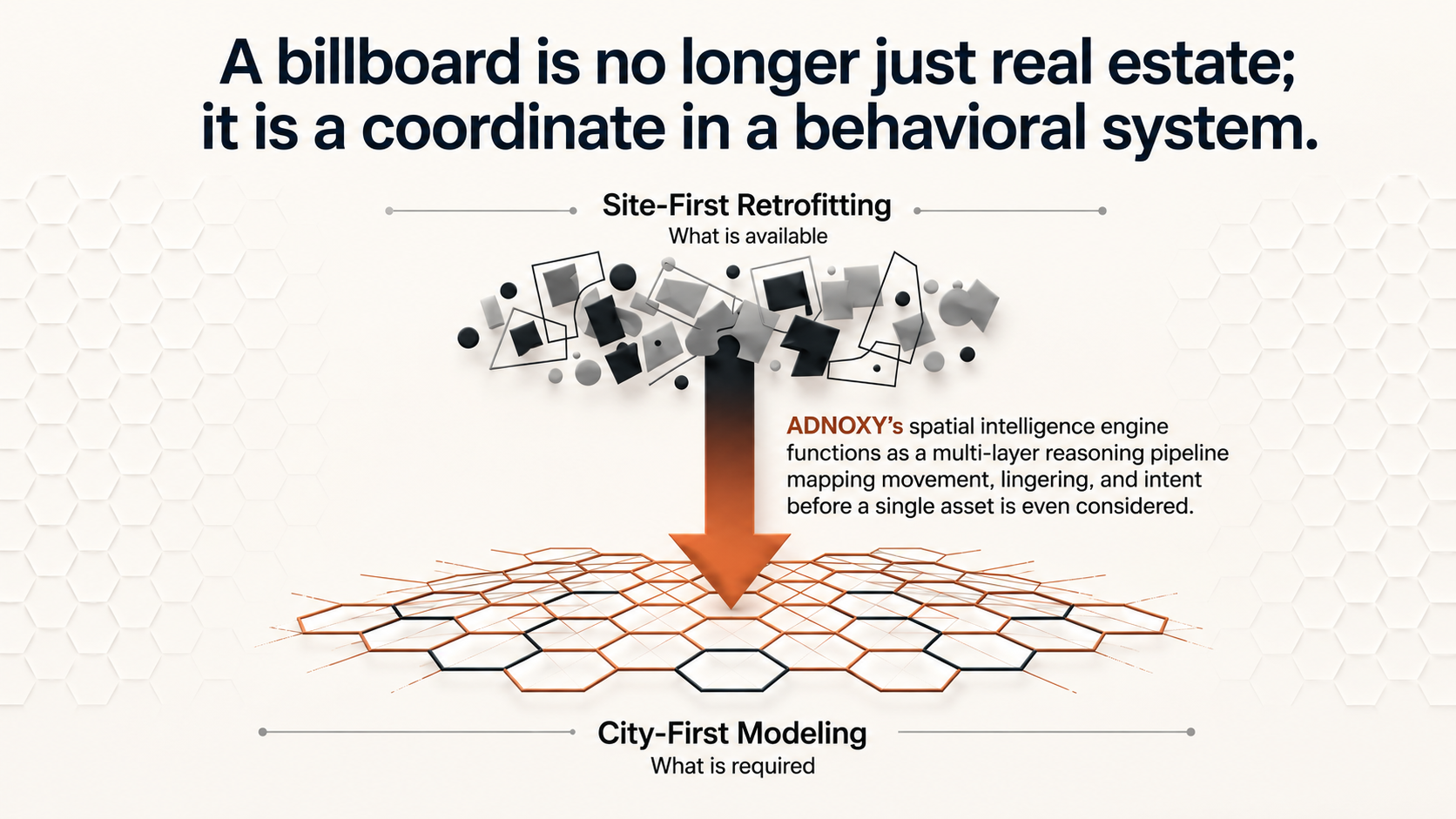
ADNOXY is not a billboard listing platform or a simple inventory aggregator, but a decision intelligence system that introduces evaluation logic into the Indian market. Most traditional systems evaluate a billboard in isolation, looking at its size, its illumination, and perhaps a rough estimate of daily traffic. This isolated view fails because billboards do not exist in a vacuum; they inherit their strategic value from the city structures surrounding them. To solve this, the engine begins by understanding the city first, modeling how neighborhoods connect, which corridors dominate movement, and where specific target audiences concentrate.
The foundation of this intelligence is the hexagonal demand model, a system that divides a city into hexagonal cells with an edge length of approximately 460 meters. Why hexagons instead of square grids? Hexagons are the most efficient shape for modeling human movement and walking distances because they tile perfectly without the orientation bias or "corner gaps" found in traditional mapping. Every one of these cells becomes a measurable behavioral unit that contains live data on movement patterns, point-of-interest density, and socioeconomic signals.
Inside these hexagonal units, the system computes four distinct scoring dimensions to evaluate every potential placement. The Audience Score measures how well a location aligns with a brand's specific persona, ensuring that a luxury brand is not wasting money in a mass-market transit zone. The Movement Score does not blindly reward high traffic volume; instead, it looks for repeat exposure and dwell conditions. The Commercial Score models the purchase environment, identifying zones where buying behavior is active, while the Intent Score evaluates if the zone fits the specific brand archetype.
This city-first approach means that an asset on a high-importance corridor scores well not because of its own physical attributes, but because of where it sits in the broader urban system. For example, a hoarding near the Jio World Convention Centre in Mumbai inherits the corporate and high-net-worth authority of its surroundings. The system models these relationships autonomously, allowing a brand to see a "heat map" of demand before they ever look at a list of available billboards.
Why supply side planning and the audit gap are failing Indian brands
The current state of outdoor advertising in India is dominated by supply-side planning, where locations enter a media plan primarily because they are available or the vendor is preferred. This creates a structural problem where two agencies can take the exact same budget and city brief and produce completely different plans. Without a neutral framework to evaluate these plans, the brand manager is left to choose based on "gut feel" or which presentation looks more polished. This lack of standardization is the reason why OOH has historically struggled to capture the same percentage of the ad pie as digital media.
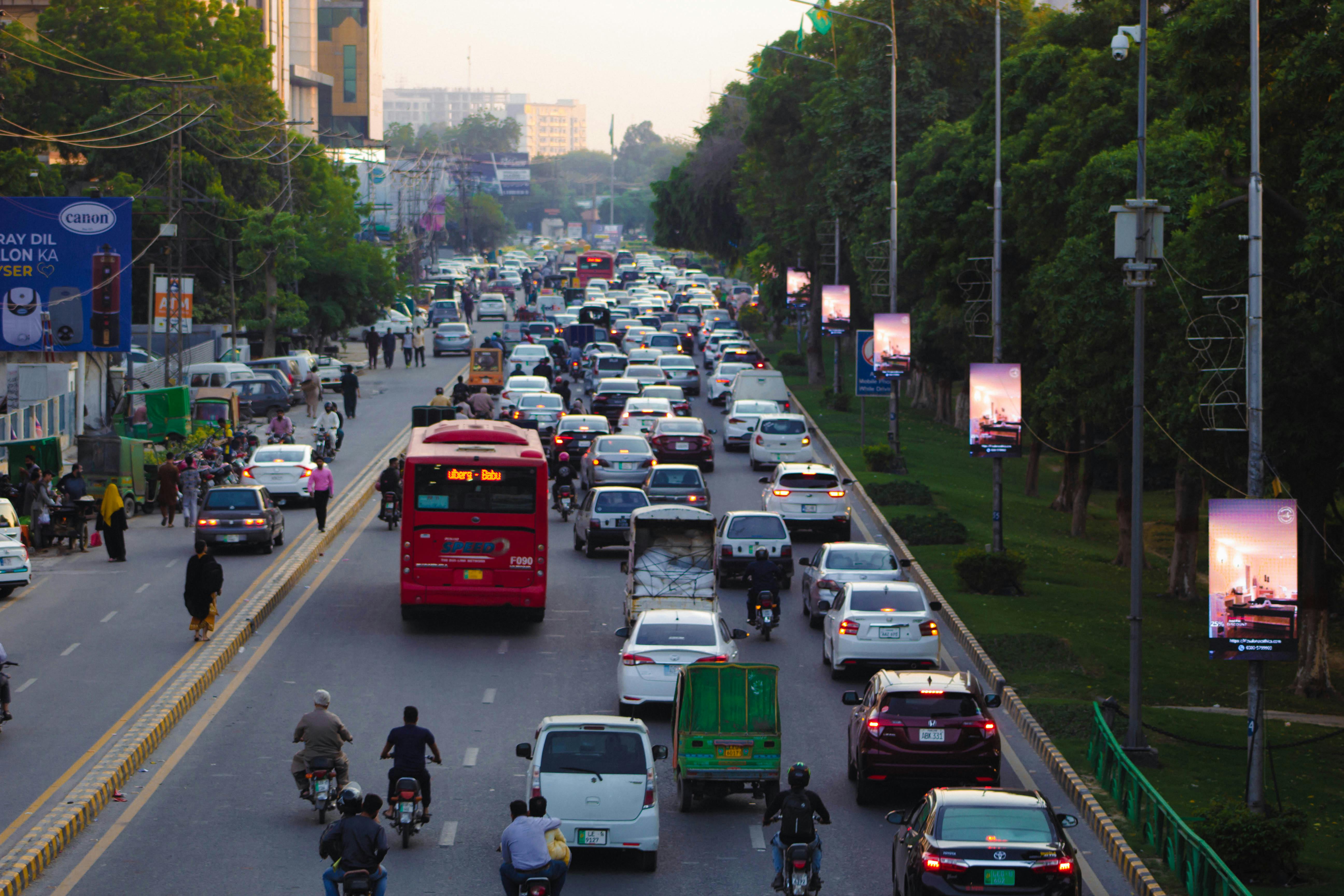
Consider a real scenario involving a scaling D2C brand trying to capture the professional audience in Gurugram. Traditional agencies might suggest massive hoardings on the NH48 expressway because of the high throughput of vehicles. However, those vehicles are often moving at 80 km/h, giving the driver less than two seconds to process a message. A smart intelligence system might instead point toward the internal connectors near Cyber City or the Galleria Market road, where traffic moves at a crawl.
In these slower environments, the congestion index is higher, meaning the driver has a longer "attention window" to engage with the brand. Most traditional planners treat traffic volume as a proxy for audience relevance, which is a fundamental error in spatial logic. ADNOXY models these distinctions explicitly, ensuring that your brand is not just seen, but actually registered by the commuter's memory.
The audit gap remains the biggest hurdle for senior marketing heads who need to defend their offline spend to leadership. When you run a campaign on Meta or Google, you receive granular data on every rupee spent, but OOH typically provides only a site list and some vague traffic estimates. Phrases like "premium location" or "near a mall" are filler, not actual analysis. By introducing standardized scoring and reasoning, every single location can be justified structurally before a single rupee moves.
| ✨ Feature |
📉 Traditional OOH Planning |
🚀 ADNOXY AI Intelligence |
| Planning Basis |
🗺️ Available inventory list |
🛑 Hexagonal city demand units |
| Success Metric |
🚗 Raw traffic counts |
⏱️ Weighted dwell time and intent |
| Auditability |
📸 Minimal (photos and estimates) |
📊 High (structured scores and reasoning) |
| Brand Specificity |
🔄 One–size–fits–all logic |
🎯 Specific brand archetypes |
| Data Source |
📋 Static vendor claims |
📡 Live movement and commercial signals |
| Outcome |
👁️ Passive visibility |
🧠 Defensible strategic recall |
How ADNOXY AI transforms movement data into defensible media strategies
ADNOXY treats the road network as a behavioral system rather than a set of traffic pipes, allowing for a more nuanced understanding of how commuters interact with brands. A billboard on the OMR IT corridor in Chennai functions differently than one in a residential neighborhood like Anna Nagar. The system uses corridor intelligence to model exposure sequencing, recognizing that a brand appearing multiple times on the same journey produces a cumulative memory effect. This sequencing is a "superpower" for driving recall, as frequency helps reinforce the message before a consumer reaches a decision point.
Instead of relying on static census labels, the system dynamically infers economic quality using live market signals through "quantum profiling". It analyzes residential price per square foot, transaction liquidity, and even the quality of commercial furnishings in a zone to build a live affluence map. This allows the platform to distinguish between "genuinely affluent" residential areas and "transit inflated" zones where the traffic is high but the target audience is absent. For a luxury brand, this distinction is critical, as they prioritize selectivity and brand authority over sheer mass exposure.
Different brand archetypes receive fundamentally different scoring logic within the platform. An FMCG brand might embrace transit movement and mass exposure corridors to drive coverage breadth. A real estate brand, however, will weight commuter corridors used by specific income segments and residential zones where the demand for new property is highest. These are not cosmetic tweaks; they are entirely different interpretations of the same city data based on what drives actual business results.
The system also produces a strategic explanation for every location, moving beyond a simple numerical score. It might identify a billboard as a "PRIMARY_ANCHOR" that creates authority in a business district, or a "COMMUTE_FREQUENCY_DRIVER" that generates repetition for daily travelers. This narrative reasoning is suitable for client presentations, allowing you to explain the specific role each location fulfills in the broader campaign strategy. You can explore the full platform at adnoxy.com.
Data and proof for an AI powered OOH advertising platform India
The scale of modern outdoor advertising is massive, and data from 2026 shows that India is now the fifth largest OOH market globally. The Indian OOH market is valued at approximately ₹4,200 crore and is projected to grow at a 12-15% CAGR to reach ₹6,800 crore by 2028, according to Shubindia Ad Works. This growth is happening as legacy formats like print readership decline, making physical billboards one of the last ways to achieve mass unskippable reach.
This is where an AI powered OOH advertising platform India provides the necessary audit trail for brands that have moved beyond simple visibility metrics. ADNOXY currently monitors over 50,000 billboard locations across India, achieving an 85% predictive accuracy in forecasting how a campaign will perform. This level of precision was previously unthinkable in the outdoor vertical, where planners typically relied on "hope and prayer" for performance measurement.
Recent studies by Nielsen India indicate that outdoor advertising has the highest ad recall rate of any media channel at 82%, significantly higher than social media ads at 38%. When OOH is combined with digital retargeting, brand recall can jump by another 48%. This physical-to-digital bridge is exactly what an intelligence platform enables, allowing brands to treat the city as an integrated performance channel.
- ₹4,700 Crore: The projected market size for Indian OOH in 2026 according to Industry Reports.
- 82% Recall Rate: The highest engagement metric among all media formats, verified by Nielsen India.
- ₹5–₹15 CPM: The lowest cost-per-thousand impressions of any media, making billboards highly cost-effective.
- 25-30% Growth: The annual growth rate of Digital OOH in India, driven by programmatic buying.
Recognized by Inc42 as one of India's Top 5 AI Startups To Watch in February 2026, ADNOXY is trusted by some of the largest brands in the country, including Tata, Axis Bank, Nivea, and Nestle. The platform covers all major metros—Mumbai, Delhi, Bengaluru, Hyderabad—and over 50 tier-2 cities where new consumer demand is rapidly emerging. As the industry moves toward outcome-led marketing, these metrics are no longer optional but essential for budget approval.
Strategic steps to modernize your outdoor marketing investment
Most marketers assume digital always outperforms physical in measurability, but the data from 2026 says otherwise when you use the right intelligence tools. In digital, you are often fighting bot traffic and ad-blockers, but a physical billboard is always on and cannot be ignored. To capitalize on this, you must shift your mindset from "buying space" to "scoring locations" based on structured data.
The first step is to demand a "city-first" analysis for your next campaign. Do not start with a list of available sites from your vendor; start with where your audience actually lives and works. Use spatial demand modeling to find the hexagonal units where your target persona has the highest density. This ensures that you are building your plan around the consumer rather than the inventory.
Next, prioritize dwell time over sheer traffic volume. A billboard on the Dwarka Expressway in Gurugram might look impressive on paper because of the "Unique Reach" of over 10,00,000, but if the traffic is moving at top speed, the actual message retention is minimal. Focus instead on "transition zones"—where audiences shift between workspaces, retail zones, and residential clusters—as these areas produce longer visual engagement periods.
Finally, ensure your campaign has a clear "Anchor" strategy. Use primary anchor sites to create authority and presence in a key business district, then use commute frequency drivers to reinforce the message throughout the week. This multi-role approach prevents your campaign from becoming "wallpaper" and ensures that every rupee is working toward a specific psychological outcome.
Evaluating the right outdoor advertising intelligence platform
The closest analogy for what ADNOXY brings to the market is a credit rating agency like Moody's. It does not predict the future with 100% certainty, but it introduces comparability and auditability into a market that used to operate on secrecy and gut feel. When choosing a platform partner, you must look for one that provides a "glass box" methodology—deterministic algorithms that you can actually understand and defend.
A reliable partner should offer multi-layer reasoning, not just a single score. You need to know why a location scored well: was it the audience alignment, the traffic behavior, or the commercial environment?. If a platform cannot explain its logic in plain English, it is just another "black box" that adds no real value to your decision-making.
You also need to verify the geographic breadth of the data. In India, the top eight metro cities account for approximately 80% of total outdoor advertising revenue, but the fastest growth is now happening in tier-2 cities like Lucknow, Coimbatore, and Bhopal. Your platform should be able to evaluate a site in a new smart city with the same rigor it uses for a site in South Mumbai.
Lastly, look for a system that integrates your brand archetype into the logic. A platform that gives the same recommendations to an FMCG giant and a luxury boutique is fundamentally flawed. The intelligence engine must be able to interpret the city differently based on your specific business goals and target persona.
Standardizing out-of-home advertising is no longer a technical challenge; it is a strategic necessity for the 2026 marketing ecosystem. The leaders who embrace these tools are the ones who will finally turn "uncluttered visibility" into a measurable, scalable science. Every billboard in your plan should have to justify its existence before you spend a single rupee.
Frequently Asked Questions
How does AI improve billboard targeting in India?
AI improves targeting by moving away from raw traffic counts and instead analyzing the city as a series of behavioral units. Systems like ADNOXY use hexagonal demand models to identify where specific audience personas concentrate, ensuring that billboards are placed where the target audience actually exists. This logic accounts for dwell time and commercial intent rather than just counting every vehicle that passes by.
What is the difference between movement scores and traffic counts?
A traffic count is a simple measure of volume, which can be misleading if vehicles are moving too fast to notice the ad. A movement score is a more sophisticated metric that factors in congestion indices, repeat exposure patterns, and "attention windows." A road with moderate traffic but high dwell time often scores higher for brand recall than a high-speed highway with massive throughput.
Why is the audit gap a problem for outdoor advertising?
The audit gap refers to the lack of granular data and standardized reporting in OOH compared to digital media. Historically, brands received only a site list and vague justifications like "high footfall," which made it impossible to audit the ROI of the spend. Intelligence platforms solve this by providing structured scores and narrative reasoning for every location, making the spend as defensible as a Meta or Google campaign.
How do brand archetypes change the media plan?
Brand archetypes are specific filters that change how the AI interprets city data. For example, a luxury brand archetype prioritizes selective, high-authority zones like corporate districts, while an FMCG archetype prioritizes mass exposure on major transit routes. By applying these archetypes, the platform ensures that the media plan is structurally aligned with the brand's unique goals and target persona.
What are the benefits of using a city-first planning approach?
A city-first approach ensures that you understand the urban movement and audience density before looking at available inventory. This prevents the "supply-side bias" where locations are chosen just because they are available or the vendor is preferred. By starting with the city's structure, you ensure that every placement in your plan fulfills a specific strategic role, such as creating authority or driving habitual memory.