
The logic engine
for commuter
attention_
Every recommendation we make is built on a clear, step-by-step evaluation. We look at how commuters move through a city and calculate how easily they will spot and remember a billboard, giving you clear reasons to choose one location over another.

The way we buy outdoor ads today is
fundamentally broken.
The industry still relies on relationships and gut feel instead of structured evaluation. Brands spend crores on locations they can't verify, agencies present plans they can't defend, and vendors push inventory that serves their margins more than your audience.
- 01Planning and execution happen in completely different silos, with no shared framework.
- 02Billboard data is scattered across messy, biased spreadsheets that favor vendors over brands.
- 03Sellers and buyers don't even use the same logic to measure a site's value.
- 04There is no neutral, independent way to prove a location actually works before money moves.
Five layers of reasoning, built into the system.
These aren't just features—they are a step-by-step evaluation process. Each layer filters out bad options and focuses your budget on the locations that matter most.
Corridor Intelligence
We don't look at isolated billboards. We analyze the entire route. We map where commuters go, how often they repeat the journey, and how traffic flows. Read our full Corridor Intelligence framework.
Attention Modeling
Traffic doesn't equal attention. We score locations based on real visibility—considering line of sight, driving difficulty (like merging), and how much clutter is around the ad. Read why visibility ≠ attention or calibrate parameters using our Sandbox Simulator.
Audience Mapping
We map where your specific target audience lives, works, and travels. We align your campaign with the exact neighborhoods and transit hubs your customers use.
Strategic Evaluation
Every location is scored against its alternatives. We evaluate how a billboard fits into the overall plan and whether it actually helps you reach your goal. Read how plans should be evaluated.
Continuous Calibration
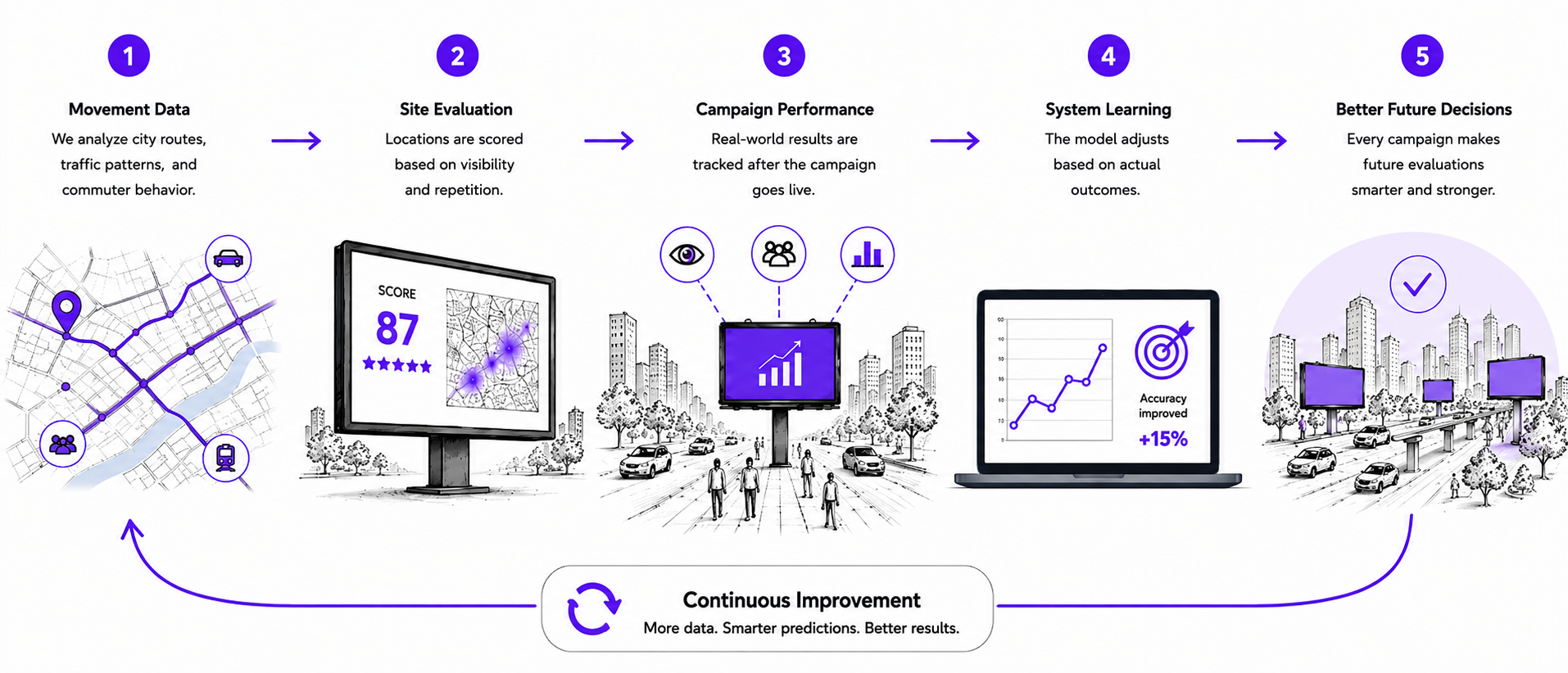
Our system gets smarter with every campaign. Real-world results are fed back into our models, constantly improving how we understand city behavior.
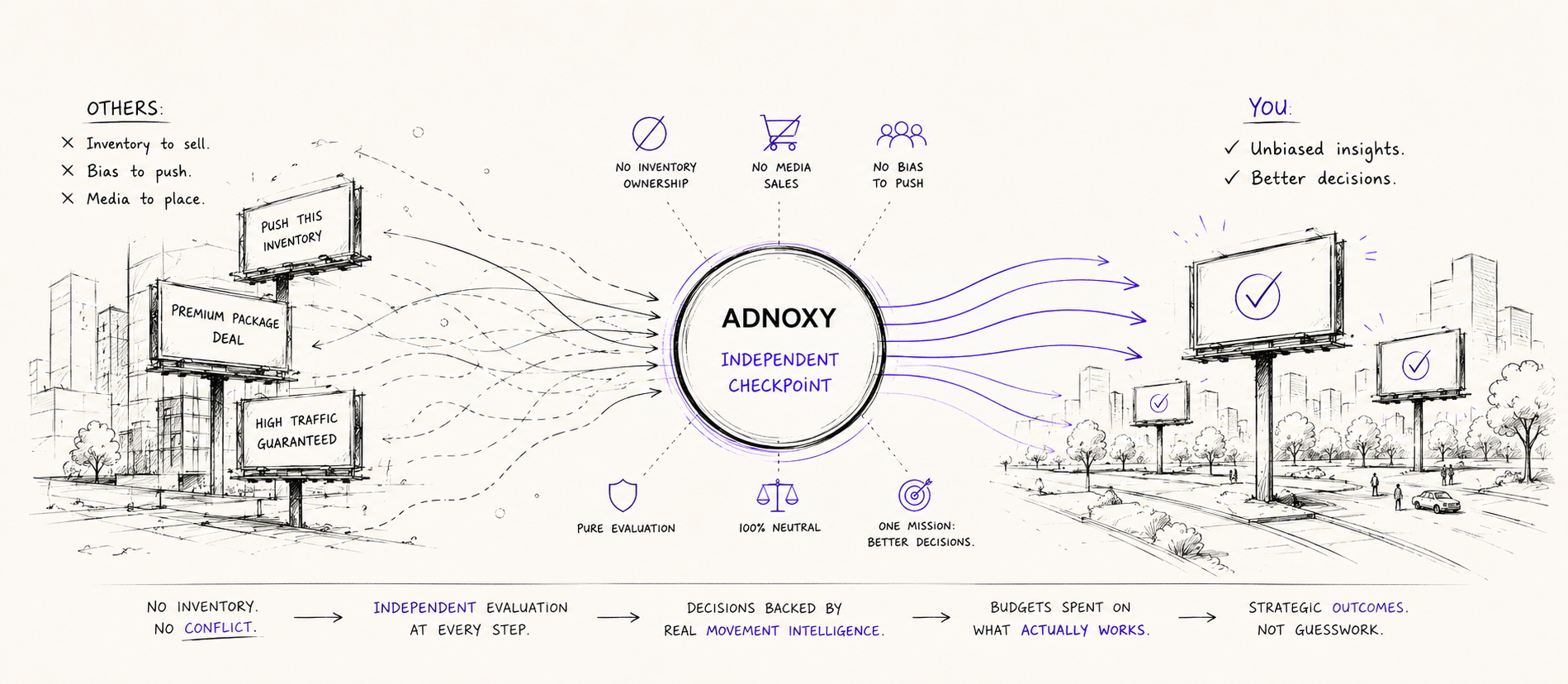
Unbiased evaluations.
Zero inventory bias.
We don't own billboards, and we don't sell media. Because we have no inventory to push, our scoring is completely neutral. We serve purely as an independent checkpoint to make sure your budget is spent on sites that actually work.
We prove performance against
observed physical behavior.
After campaigns run, we compare predicted corridor performance against observed movement and exposure behavior. Those differences are used to recalibrate future scoring, ensuring our predictions stay grounded in physical reality.
Workspaces for defensible decisions.
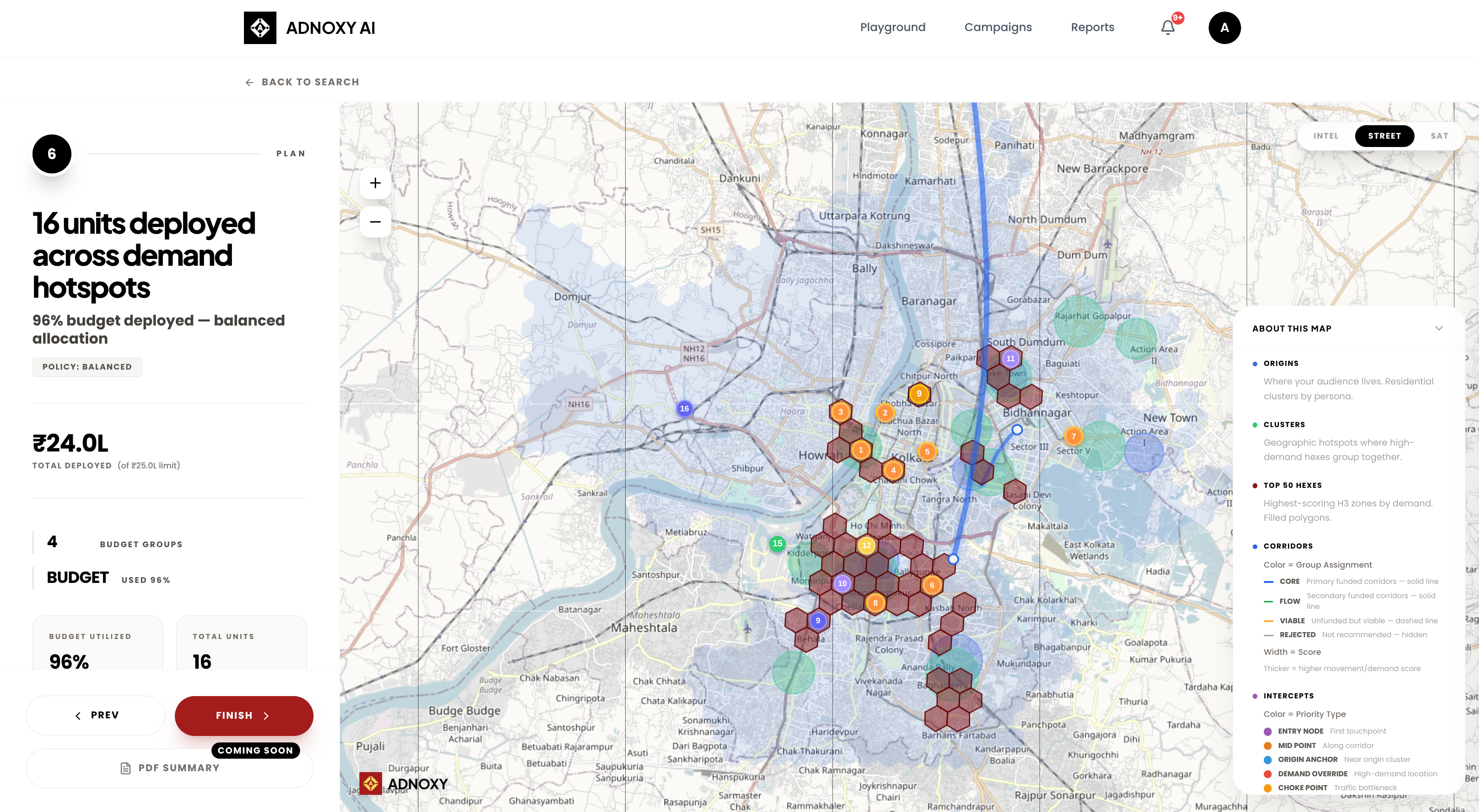
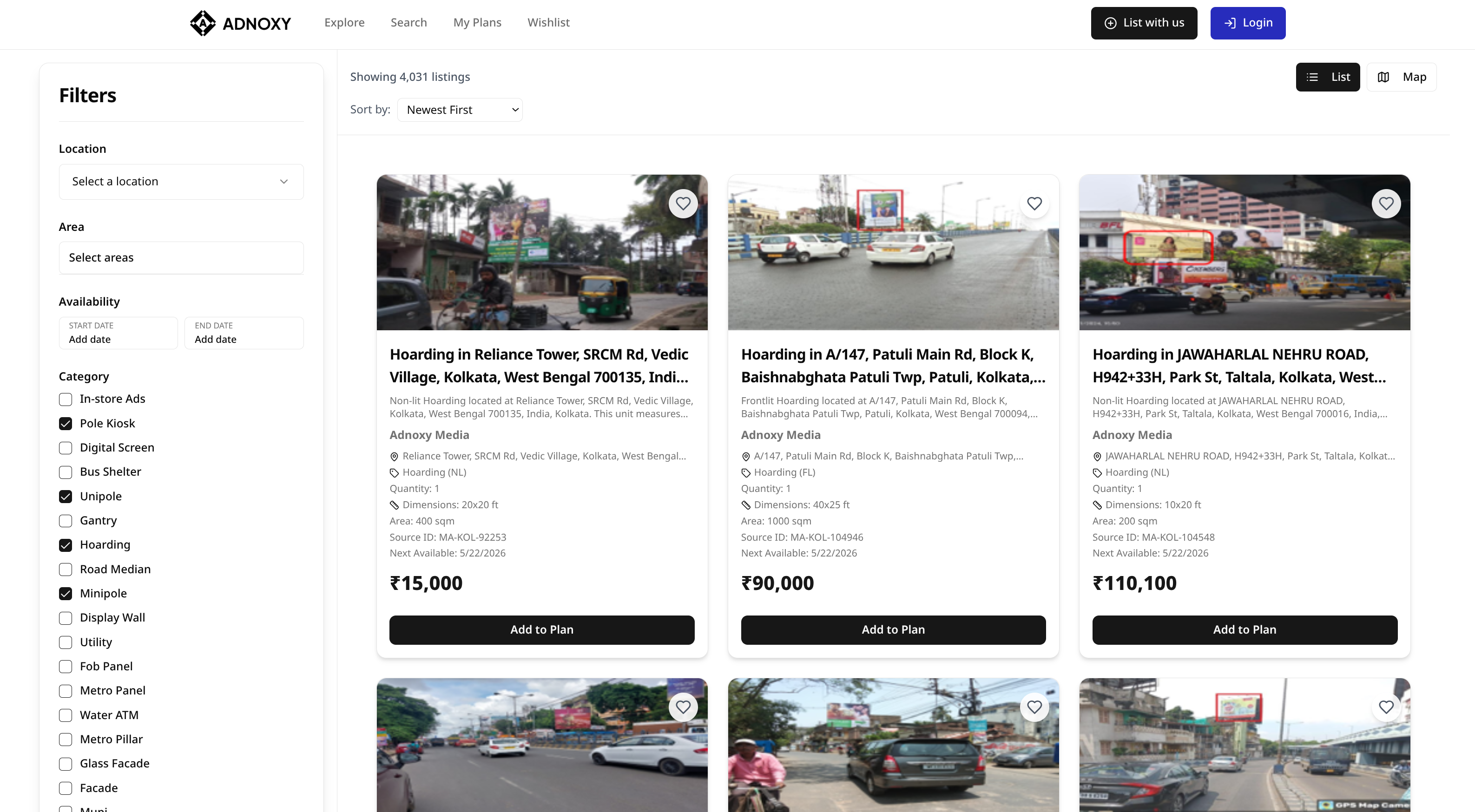
We separate spatial evaluation from physical execution. Adnoxy provides two distinct workspaces: one to calculate and score corridor repetition, and another to coordinate inventory validation.
The analytical environment for campaign validation. Planners use this workspace to evaluate coordinate paths, measure commuter loop repetition, and calculate foveal viewing cones to score potential placements before committing budget.
The execution environment to coordinate verified plans. Once corridor scores are finalized, teams use this workspace to match evaluated requirements directly against physical inventory listings, bypassing relationship bias and manual vendor coordination.
Understand the logic
before you commit._
Walk through a real location evaluation or request a sample analysis for your city. See exactly how corridor reasoning, visibility scoring, and audience mapping work in practice.
No commitment. Just clarity on how the system thinks.
A walkthrough of the scoring framework. Real examples. Clear reasoning behind every recommendation.