Implementing artificial intelligence OOH advertising India demands far more than bolting digital screens to busy intersections; it requires completely restructuring how spatial value is calculated, audited, and traded. The era of purchasing outdoor media based solely on vendor relationships and arbitrary traffic estimates is rapidly collapsing under the weight of required financial accountability. Decision-makers now face an environment where infrastructure expansion actively outpaces the analytical capabilities of traditional media agencies, forcing a reckoning in how budgets are allocated.
The year 2026 marks a structural reset for the outdoor sector across the subcontinent. Following a massive growth trajectory where sector spending comfortably surpassed the forty-five billion rupee mark, advertisers are aggressively recalibrating their expectations. The physical canvas of major metropolitan areas is expanding through rapid transit projects, yet legacy planning methodologies remain stubbornly disconnected from these new human mobility patterns. Marketers actively reject the historical indulgence of unverified visibility, demanding precise, data-backed resonance that aligns with comprehensive full-funnel digital strategies. You can no longer justify a massive hoarding purchase simply because it sits on a famous road.
Understanding artificial intelligence OOH advertising India
Understanding the architecture of a smart billboard platform begins by discarding the assumption that geographic coordinates alone dictate asset value. The system operates on a multi-layer reasoning pipeline, prioritizing city-wide structural comprehension over isolated site analysis. The engine first maps how different urban districts connect, identifying which specific neighborhoods anchor daily movement and where target demographic concentrations naturally occur throughout the day. Individual outdoor assets subsequently inherit their strategic value from these larger, macro-level structural dynamics.
Most planners still do not know this.
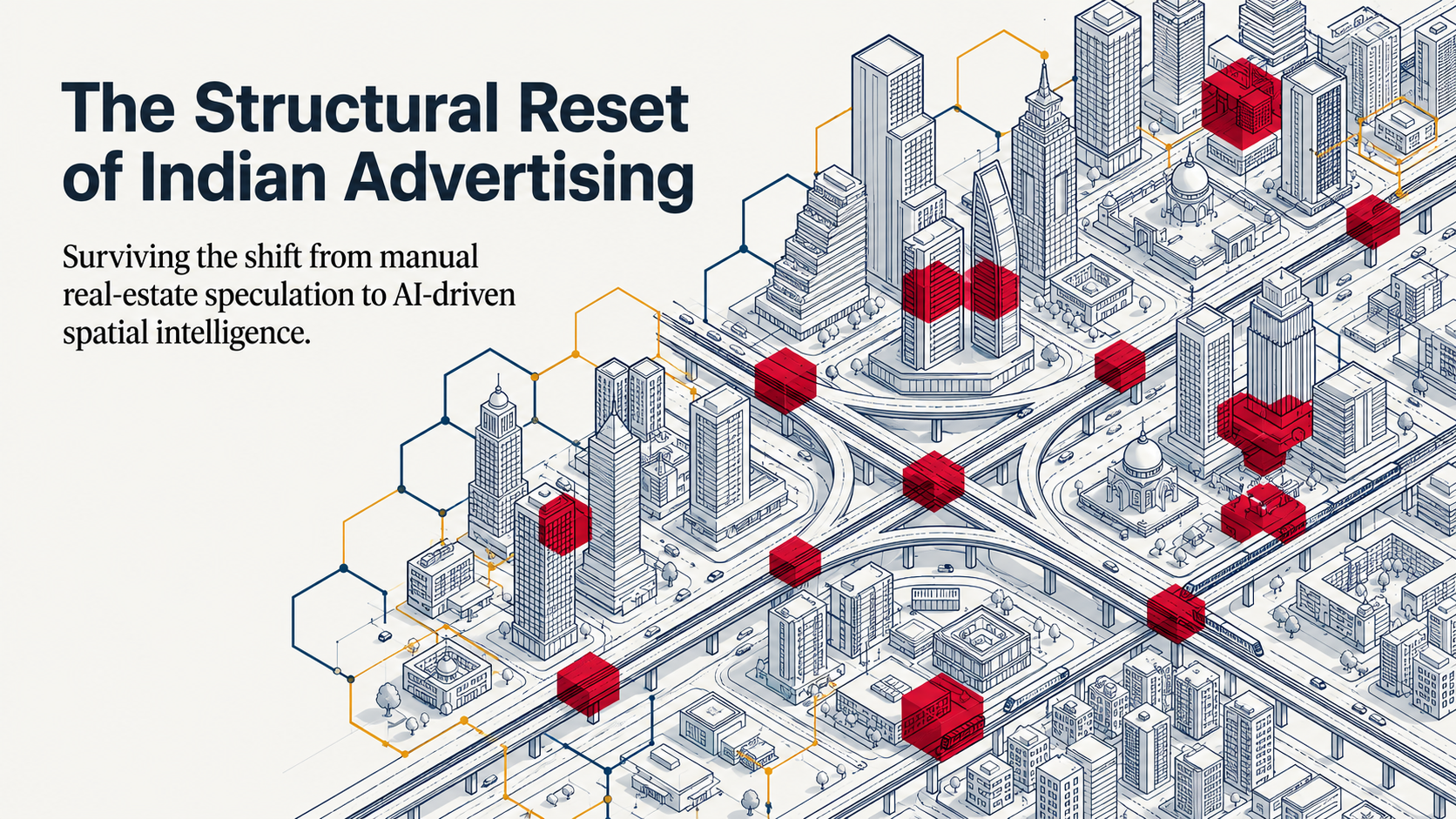
The analytical foundation rests upon a hexagonal demand model, dividing urban geography into precise cells with an edge length of approximately four hundred and sixty meters. Every single hexagonal unit transforms into a measurable behavioral zone containing continuous movement data, point-of-interest density metrics, audience composition analytics, and specific corridor structures. Planners can evaluate these units precisely. The methodology completely replaces the outdated practice of drawing arbitrary circles on a printed map.
Evaluation relies on four distinct scoring dimensions. The Audience Score measures exact persona alignment and affluence fit within the cell. The Movement Score rewards conditions that generate repeat exposure and high dwell times, explicitly penalizing raw, high-speed traffic volume. The Commercial Score models the immediate purchase environment surrounding each location. Finally, the Intent Score evaluates whether a specific geographic zone genuinely matches the underlying campaign objective and the established brand archetype.
The closest structural analogy exists within financial markets, mirroring how Moody's operates as a credit rating agency. Moody's does not predict future market outcomes with absolute certainty; rather, it introduces comparability, rigorous scoring standards, and structured decision logic into debt markets that would otherwise rely entirely on opaque institutional trust. By analyzing historical borrowing records, current cash flows, and future earning potentials, financial rating agencies provide a neutral framework for evaluation. Similarly, a decision intelligence engine introduces standardized evaluation logic into an outdoor media market that currently functions almost entirely on intuition, fragmented vendor negotiations, and unverified promises.
Different brand archetypes mandate entirely different interpretations of the exact same city data. Luxury automotive brands must prioritize high-street locations and elite corporate districts to maintain necessary prestige signaling. Fast-moving consumer goods companies require mass exposure transit corridors to drive low-cost, high-frequency awareness. Real estate developers weight commuter corridors used explicitly by their target income segments. Such requirements represent fundamental strategic realignments rather than minor cosmetic adjustments to a spreadsheet.
The platform guarantees absolute explainability for every single asset selected. Instead of relying on vague justifications involving premium visibility or high footfall, the system assigns specific behavioral roles to each billboard. A PRIMARY ANCHOR board creates immediate authority within a target zone. A COMMUTE FREQUENCY DRIVER generates necessary repetition along a daily path. CORPORATE SIGNAL BOARD units project credibility in dense professional districts. Meanwhile, a LOCAL RECALL SUPPORT placement reinforces memory within surrounding residential contexts.
Why traditional outdoor campaign planning fails
Consider a major real estate developer attempting to market luxury apartments near the Bandra Kurla Complex in Mumbai. A traditional agency will typically secure hoarding space along the Western Express Highway, justifying the selection by citing traffic throughput exceeding four hundred thousand vehicles daily.
That is a problem. A big one.
Legacy supply-side planning dominates the current ecosystem to the detriment of actual brand performance. Locations enter media plans primarily because they are currently available in a vendor's inventory portfolio, or because that specific vendor maintains a deep financial relationship with the buying agency. Agencies frequently take the exact same client brief, identical budgets, and the same target city, yet produce entirely contradictory execution plans. There is currently no neutral framework available to evaluate which proposed plan is structurally superior, a problem that digital advertising resolved over two decades ago. Procurement teams often treat outdoor buys as a basic extension of television planning, negotiating purely on surface-level cost reductions rather than assessing the genuine strategic value of the placement.
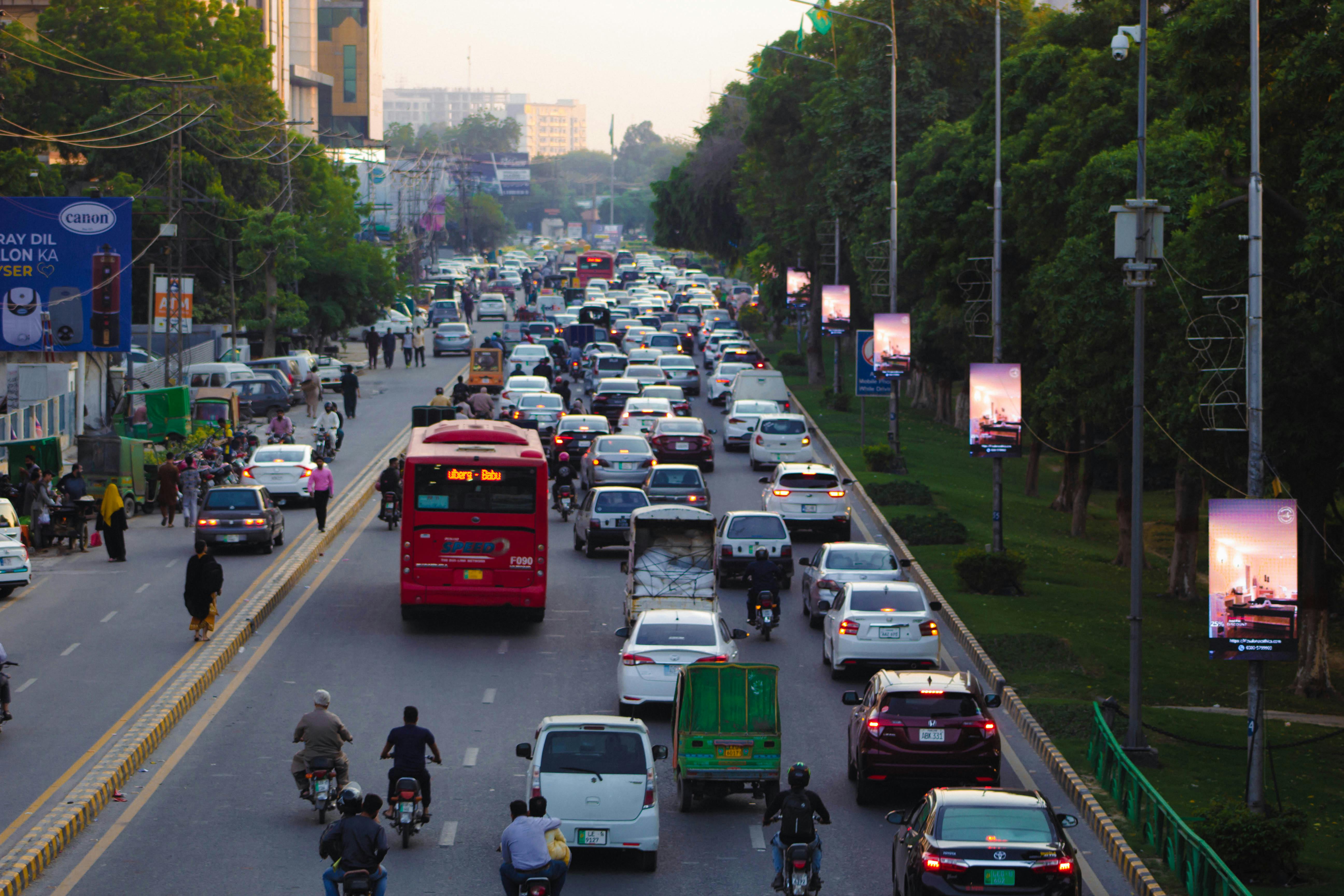
Traffic volume actively destroys campaign memory if the movement speed prevents adequate cognitive processing. A massive gantry positioned on a high-speed flyover might register massive daily impressions, but the actual ad recall rests near zero because commuters physically lack the time to read the messaging. Conversely, a smaller arterial road experiencing moderate traffic, but characterized by heavy commuter congestion and repeated daily usage, produces significantly stronger memory effects. You must look beyond raw vehicle counts to understand how an audience actually interacts with the physical space.
To be completely direct about a reality most tech providers refuse to admit—full attribution for a static hoarding in a tier-3 city is still genuinely difficult. Anyone selling you a complete solution for that specific offline-to-online conversion problem is oversimplifying the severe limitations of mobile GPS drift and polygon boundary drawing. If a vendor cannot explicitly explain how they define a "visit" to a physical store, you should treat their footfall attribution reports as purely promotional marketing material. Drawing an overly generous polygon around a retail center will capture thousands of false positives from adjacent businesses or passing pedestrians, rendering the resulting data entirely useless for serious media optimization.
Visual clutter further exacerbates these geographic and measurement failures. Agencies frequently adapt complex print advertisements directly for outdoor spaces, crowding the physical canvas with multiple product images, extensive explanatory text, and redundant contact information. Commuters navigating the Delhi-Gurgaon Expressway possess approximately three to six seconds to perceive and comprehend a message. Industry veterans consistently emphasize that an outdoor creative using more than five or six words essentially renders itself invisible to the passing public. A cluttered design overwhelms the viewer, ensuring that the central brand narrative is completely ignored.
Location-audience mismatch occurs with alarming frequency across major Indian metros. Brands routinely place advertisements for affordable student housing on billboards directly facing luxury villas in Lutyens' Delhi, or showcase high-end German automobiles in markets known primarily for wholesale goods. Every single rupee spent on these placements is entirely wasted because the message reaches the wrong demographic profile. Furthermore, brands approve sites based on outdated reference photographs, failing to realize that new construction, grown trees, or poor illumination have completely obstructed the real-world view of the hoarding.
Smart location reasoning and decision intelligence
The current ecosystem requires a fundamental inversion of the traditional supply-side model. Instead of beginning with available vendor inventory and attempting to force an audience fit, advanced spatial intelligence engines start by identifying where the required audience actually exists, subsequently locating the appropriate media assets to reach them.
The operational architecture of ADNOXY operates across two simultaneous levels. The present reality involves a highly efficient media planning and proposal business that sources outdoor inventory, generates branded campaign proposals, and manages complex execution workflows. The actual technological build, however, is a sophisticated spatial intelligence engine capable of continuously evaluating urban environments, modeling movement behavior, and generating defensible media strategies completely autonomously. Both levels are entirely real; the first operation pays the bills, while the second represents the actual company vision.
When we first built the hexagonal scoring model, the question we kept getting from clients wasn't 'how accurate is it?' — it was 'can you show me which zones my competitor is not covering?' That question changed how we think about the entire platform.
The product suite reflects this dual operational nature through specific, targeted layers. ADNOXY AI functions as the core intelligence and planning engine, processing vast amounts of spatial data to generate strategic recommendations. ADNOXY Connect serves as the inventory marketplace layer, bringing fragmented supply into a unified, transparent procurement environment. Finally, ADNOXY Command acts as the customer relationship management interface, ensuring tight campaign oversight and verified proof-of-play auditing. Explore the full platform at adnoxy.com.
Corridor intelligence completely redefines how media planners view road networks. The system treats transit routes as dynamic behavioral systems rather than static traffic pipes. Exposure sequencing—where a brand strategically appears on the exact same corridor multiple times during a single consumer journey—produces cumulative memory effects that isolated, massive placements can never replicate. The intelligence engine maps these sequences automatically, identifying the optimal distance between placements to maximize recall without triggering creative fatigue.
Planners must recognize that distinct urban environments require entirely distinct planning methodologies. Affluence mapping represents a critical operational function, distinguishing between genuinely affluent residential neighborhoods, commercially expensive business districts, and transit-inflated zones that artificially boost apparent wealth metrics. A highly affluent executive might travel through a lower-income transit corridor, artificially spiking the perceived affluence of that specific road if measured purely by mobile device data. The intelligence engine filters out these transit anomalies, ensuring that your brand invests in locations where high-net-worth individuals actually reside and shop, rather than just places they briefly drive through.
Digital out-of-home networks are no longer experimental additions to a media plan; they represent the structural baseline for premium brand execution. The widespread deployment of high-definition screens across airports, premium malls, and rapid transit networks allows for programmatic buying models that rival online advertising in terms of contextual flexibility. Advertisers gain the unprecedented ability to deploy creative assets dynamically, triggering specific messaging based on real-time weather conditions, daily traffic congestion levels, or specific audience profiles present at that exact moment. This capability completely eliminates the static rigidity that historically plagued the outdoor sector.
Market data and predictive campaign forecasting
The outdoor sector delivered an 82% ad recall rate last year, according to Nielsen India—the highest of any media channel, including television and digital displays. Additionally, the broader digital out-of-home advertising market generated revenues reaching approximately USD 282.6 million recently, with an expected compound annual growth rate of 13.8% through the end of the decade. Even basic static formats maintain exceptional cost efficiency, with hoarding costs frequently resting between five and fifteen rupees per thousand views across major metropolitan corridors.
Finding the optimal intersection of cost and visibility is precisely where artificial intelligence OOH advertising India separates sophisticated media buyers from legacy operators.
When the broader ecosystem is evaluated properly—including transit media, municipal inventory, retail displays, highway sites, and expanding digital screen networks—the Indian outdoor industry is actually closer to INR 7,000 crore in total value, growing at an estimated 10–12 percent annually. Much of this substantial economic growth remains entirely under-captured because outdated measurement models focus exclusively on the top metropolitan cities, while the actual expansion is geographically distributed across emerging regions. The market is not declining alongside print media; it is aggressively diverging from it.
As one media planner put it: "We stopped trusting gut feel the day ADNOXY showed us the data."
The underlying intelligence system currently analyzes over 50,000 billboard locations nationwide, achieving an 85% predictive accuracy rate in campaign performance forecasting. These formidable analytical capabilities led Inc42 to feature the platform as one of India's Top 5 AI Startups To Watch in February 2026. Major corporate entities, including Tata, Axis Bank, Nivea, and Nestlé, rely on the architecture to navigate complex inventory landscapes across Mumbai, Delhi, Bengaluru, Hyderabad, Pune, Ahmedabad, Chennai, Kolkata, and more than 50 emerging tier-2 cities.
Market momentum beyond the primary metropolitan areas presents extraordinary opportunities for early adopters. Expanding infrastructure projects across regions like Nagpur, Pune, Kochi, and Kanpur constantly generate high-attention media environments. New roads, upgraded bus terminals, and gleaming airport terminals are fundamentally changing how millions of citizens move every single day. For years, brands viewed these specific markets as secondary concerns, but the combination of rising disposable incomes and predictable commuter patterns is turning smaller cities into high-frequency, high-impact advertising zones.
To fully capitalize on this regional growth, you must demand proper audience measurement data sources. Evaluating digital verification means understanding the distinct differences between Google mobility trends, raw telecommunication carrier data, and highly specific SDK data embedded within consumer applications. Advanced measurement systems calculate Visibility Adjusted Contacts, factoring in the specific angle of the hoarding, optimal viewing distance, illumination quality, and the precise speed of passing traffic. By combining deterministic signals from mobile networks with visual auditing protocols, brands can finally hold outdoor vendors to the same rigorous performance standards expected from digital performance marketing agencies.
Strategic guidance for Indian media planners
Deploying artificial intelligence OOH advertising India successfully requires abandoning outdated proxy metrics in favor of verified behavioral intelligence. Strategic planning must evolve from simple inventory booking into a rigorous examination of how your specific target demographic moves, shops, and consumes information in the physical world. Marketers must force their agency partners to explain exactly why a specific location appears on a media plan, demanding quantifiable justification that extends far beyond a vendor's arbitrary discount offer.
Here is the part that usually surprises people.
A massive highway flyover with maximum throughput is often the worst possible location for your campaign. High transit speeds severely restrict the cognitive processing time required for a consumer to transition from initial brand awareness to actual purchase consideration. You are purchasing raw impressions that completely fail to convert into memory. A slower neighborhood arterial road, characterized by frequent traffic signals and heavy daily commuter repetition, generates significantly higher ad recall despite showing a lower total daily vehicle count.
When executing campaigns for fast-moving consumer goods, strategy teams must utilize verified purchase data to understand specific offline shopping habits. Demographic profiles alone cannot predict whether a consumer will actually place a specific health food brand into their physical shopping basket. By overlaying actual purchase behavior data onto geographic mobility maps, FMCG marketers can place media assets precisely along the paths leading directly to major retail centers, capturing the consumer in the crucial moments right before a transaction occurs.
Premium B2B campaigns must target environments possessing extremely high dwell times. Locations such as the DLF Cyber City hub in Gurugram or the Bandra Kurla Complex in Mumbai offer massive concentrations of executive decision-makers. In these specific zones, the strategy is not mass reach, but rather intense corporate signaling. Large-format digital billboards placed near prominent corporate headquarters allow brands to project authority and market leadership to a highly curated audience of high-net-worth individuals.
The return of static media represents another critical strategic shift. As severe digital fatigue sets in across the consumer landscape—with audiences actively scrolling past online advertisements and trusting mobile screens less—the physical, unskippable presence of a massive static hoarding is becoming premium once again. While digital networks offer incredible programmatic flexibility, large-format static billboards provide an enduring sense of brand authority and permanence that rotating digital screens simply cannot replicate. You must balance your media mix, using digital out-of-home for tactical, time-sensitive messaging while relying on static assets to anchor your long-term brand identity in the physical world.
Safety and compliance must also remain a top priority for media planners. Following tragic hoarding collapses in major cities, the industry is increasingly viewing outdoor media as critical public infrastructure rather than just advertising space. Brands must insist on verified structural audits and continuous compliance monitoring to ensure their marketing investments do not inadvertently associate them with public safety hazards. Utilizing technology platforms that capture real-time visual proof from every campaign site guarantees that your media is not only highly visible but also structurally sound and fully compliant with local municipal regulations.
Selecting the right spatial intelligence partner
During a recent massive festive season planning cycle, a marketing director for a national automotive brand faced two competing proposals for the exact same budget. The legacy media agency presented a massive spreadsheet filled with heavily discounted static hoardings scattered across the city, justifying the plan entirely on the low cost-per-impression. The competing technology-led vendor presented a highly focused strategy featuring a prominent digital gantry on the Mumbai-Pune Expressway, charging a significantly higher premium for the specific placement.18
The deciding factor was not the price. The director chose the technology-led proposal because the vendor could explicitly articulate the structural role of that specific gantry within the broader regional mobility system. They provided a detailed map showing the precise percentage of target demographics passing the location during optimal commuting hours, combined with exposure sequencing data demonstrating how the placement reinforced memory. The buyer recognized that purchasing isolated visibility without behavioral context essentially amounted to financial waste. Comprehensive analytics provided the necessary justification to secure budget approval from the internal finance committee, demonstrating a clear, logical path from outdoor exposure to potential dealership footfall.
| Market Tier |
Asset Format |
Average Monthly Traffic Volume |
Estimated Monthly Investment (INR) |
| Tier 1 (Mumbai - WEH) |
Highway Unipole |
400,000 - 500,000 vehicles |
₹5,00,000 - ₹10,00,000 |
| Tier 1 (Delhi - NH-8) |
Digital Gantry |
300,000 - 450,000 vehicles |
₹6,00,000 - ₹12,00,000 |
| Tier 2 (Coimbatore) |
Static Hoarding |
100,000 - 150,000 vehicles |
₹50,000 - ₹2,50,000 |
| Tier 2 (Jaipur) |
Digital Screen |
120,000 - 180,000 vehicles |
₹1,00,000 - ₹4,00,000 |
You must demand complete transparency from any spatial intelligence partner. The Indian outdoor ecosystem continues to face severe structural challenges, including highly fragmented ownership, contradictory state-level policy frameworks, and the glaring absence of a unified national measurement currency. These issues make evaluating vendors exceptionally difficult. If a platform relies entirely on black-box algorithms and refuses to explain exactly how their scoring models weight different variables, they are likely masking a fundamental lack of real-world data integration.
Evaluate potential partners based on their ability to solve the fragmentation paradox. The right platform will seamlessly aggregate inventory from thousands of independent regional vendors while applying a uniform, standardized grading system across the entire network. They will offer explicit proof-of-play auditing, utilizing geo-tagged images and real-time operational monitoring to eliminate the widespread pilferage and negligent upkeep that plagues traditional campaigns. Ultimately, you are not buying software; you are buying the ability to defend your marketing budget against intense financial scrutiny.
The fundamental shift in outdoor media is permanently altering how Indian brands establish physical dominance. Stop accepting vague visibility estimates and demand absolute spatial accountability. Force your agency partners to justify every coordinate on the map with verified behavioral logic, or risk losing market share to competitors who already understand that the street is the most powerful performance channel available.
Frequently Asked Questions
How does the hexagonal demand model improve media planning?
The system divides cities into 460-meter cells to measure continuous movement patterns rather than isolated traffic counts. This structure ensures brands buy locations based on verified behavioral data instead of relying on subjective vendor recommendations. ADNOXY applies this exact architecture to score every neighborhood objectively before suggesting inventory.
Why is traffic volume considered a misleading metric?
High traffic speeds drastically reduce the cognitive processing time available to commuters, frequently resulting in near-zero brand recall. A slower arterial road with repeat local commuters generates far more effective memory retention than a massive highway flyover. The platform explicitly penalizes raw traffic volume if the corresponding dwell time is too brief.
What differentiates digital out-of-home from static billboards?
Digital networks allow for programmatic buying, dayparting, and dynamic creative rotation based on real-time environmental triggers. Static boards remain highly effective for long-term brand authority, but digital screens offer the flexibility of digital campaigns within the physical world. ADNOXY Connect bridges both formats into a single, unified procurement dashboard.
How do luxury and mass-market brands target differently?
Luxury campaigns demand high-street proximity and corporate district placements to maintain strict prestige signaling. Mass-market consumer goods prioritize extensive transit networks and high-frequency commuter corridors for maximum exposure. The intelligence engine maps these specific brand archetypes against city mobility patterns automatically.
Can offline billboards actually drive measurable store visits?
Yes, provided the measurement relies on accurate mobile location data and strictly defined retail polygon boundaries. Loose geofencing creates massive false positive rates, which ruins attribution accuracy. ADNOXY Command requires highly specific location parameters to ensure reported footfall matches genuine store traffic.