Implementing machine learning OOH campaign optimisation across India's fragmented urban corridors allows growing consumer brands to stop wasting marketing budgets on low-impact billboards that do not reach their target buyers. Without verified spatial data, choosing an outdoor location remains an expensive gamble where marketing heads are forced to rely on media agency relationships rather than hard metrics. This lack of clear accountability is the primary structural hurdle preventing offline media from capturing its rightful share of modern advertising budgets.
As India's nominal gross domestic product continues to expand, brands are pouring historic budgets into real-world advertising, with the overall Indian ad market crossing ₹1,11,000 crore in 2025. Physical presence in our major metros is regaining massive strategic importance because digital channels have become incredibly cluttered and prone to severe banner blindness. With the rapid rollout of metro networks adding six kilometers of new track every single month across the country, new high-impact transit media sites are emerging in major economic zones almost overnight. Standardizing this exploding inventory is the only way for forward-thinking brand managers to achieve measurable campaign performance.
Demystifying spatial intelligence and the hexagonal demand model
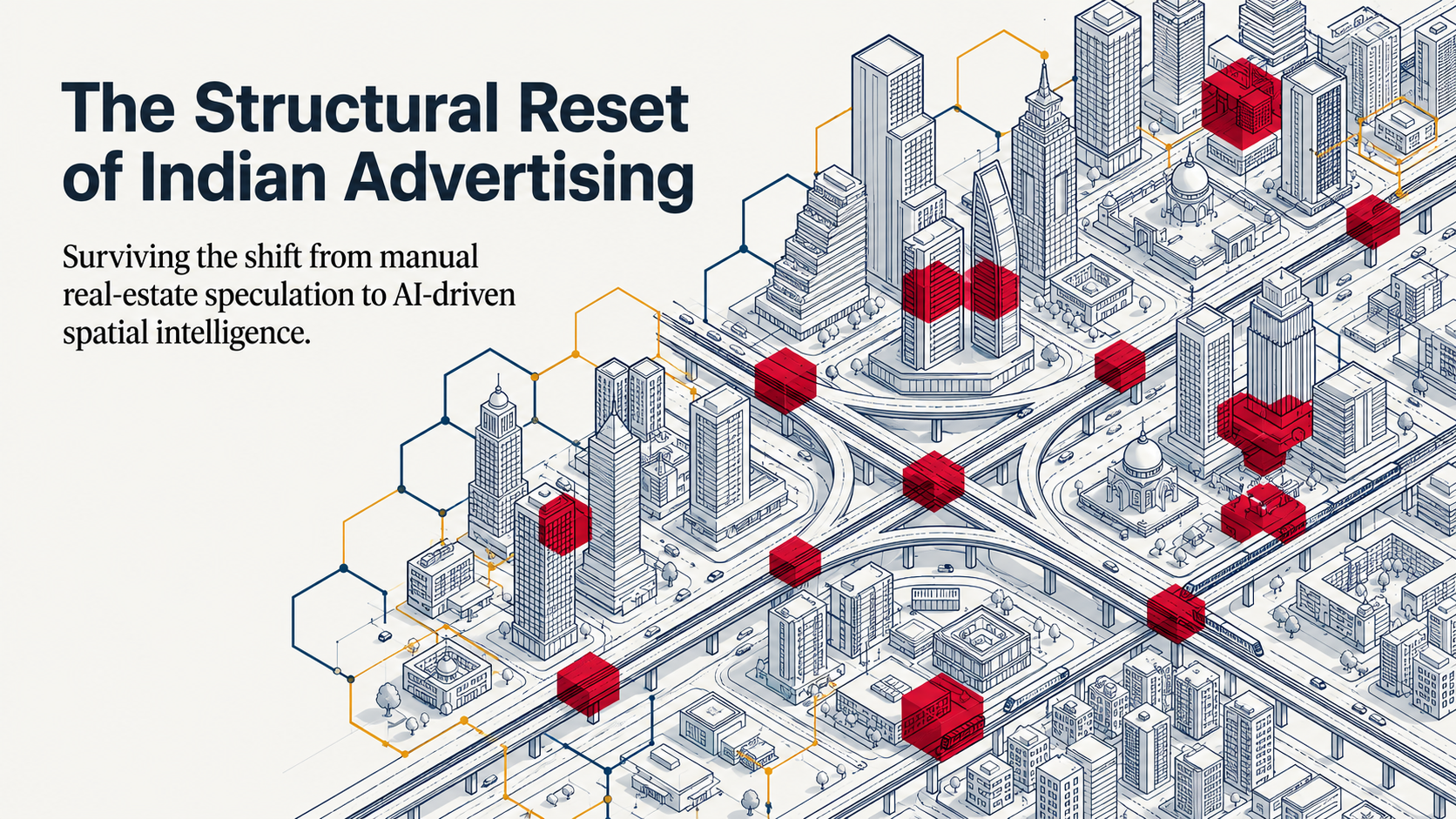
Modern outdoor advertising intelligence platform options must move beyond evaluating isolated billboard sites to understand the underlying structure of the city itself. Traditional media planning typically treats a hoarding as a static asset, looking only at physical dimensions and generic vehicle passage counts. In contrast, a smart system treats assets as inheritors of the value generated by the corridors they sit on.
By dividing the city grid into precise hexagonal cells, each measuring approximately 460 meters in edge length, the technology establishes a rigorous grid. Every individual hexagon acts as an independent behavioral unit, dynamically aggregating local point-of-interest density, live transit patterns, and consumer affluence indicators.
Inside these hexagonal units, the scoring engine computes four distinct indicators: Audience, Movement, Commercial, and Intent. The Audience Score maps demographic fit, while the Movement Score tracks dwell conditions and repeated exposure patterns rather than raw traffic volume. Commercial and Intent Scores evaluate the active purchasing environment and structural campaign alignment respectively. Consequently, a luxury brand and an FMCG brand will see completely different heat maps of the exact same city corridor.
Most planners still do not know this.
They continue to evaluate media sites in isolation, ignoring how different audiences move through urban spaces during their daily routines. By analyzing the city as a living behavioral system, machine learning tools make physical campaigns highly targeted.
Why supply-side planning dominates and the structural audit gap
The current outdoor media environment in India remains heavily biased toward the supply side, meaning billboards enter plans because of vendor relationships rather than audience density. Consider a recent scenario where a fast-growing direct-to-consumer beverage brand planned a major product launch targeting young, health-conscious professionals across the highly competitive Delhi NCR belt. Traditional agencies presented massive, high-cost hoardings along the NH48 expressway, citing a spectacular unique reach of over nine lakh daily commuters.
When the campaign ran on those high-speed highway sites, the results were highly disappointing because vehicles zipped past at eighty kilometers per hour, leaving drivers with less than two seconds of exposure time. The brand spent lakhs of rupees for impressions that did not translate into brand recall or subsequent retail walk-ins. A subsequent diagnostic analysis showed that local commuter traffic on the arterial roads near Galleria Market in Gurugram, where vehicles crawl during peak hours, would have generated three times the retention at half the cost. Such outcomes highlight the classic failure pattern of buying raw traffic instead of attention.
Nobody talks about this openly.
To be direct about something most platforms will not say, full attribution for a static hoarding in a tier-3 city is still genuinely difficult. The data models exist, but the physical ground-truth verification infrastructure in smaller, emerging markets is still catching up. Anyone selling you a complete real-time solution for that specific tier-3 problem is oversimplifying it.
Solving the offline audit gap with machine learning OOH campaign optimisation
ADNOXY resolves this structural uncertainty by introducing standardisation, scoring, and clear explainability into the outdoor media ecosystem. The platform operates like a neutral rating agency, evaluating every physical site against consistent, objective spatial benchmarks. Objective scoring blocks the conflict of interest inherent in media plans designed by inventory owners.
Instead of static lists, the platform offers corridor intelligence that models roads as dynamic behavioral systems where traffic speed, congestion index, and exposure sequencing are analyzed. Our platform allows you to plan campaigns that build cumulative memory effects by placing message sequences along habitual commuter paths.
We do not sell space, we score it. When clients first see our hexagonal demand model, the question is almost never about accuracy; it is always about which zones their competitors have not covered yet. That specific question changed how we think about the whole platform, prompting us to build deeper competitive intelligence into our campaign recommendations. By incorporating active rival positioning into the scoring logic, we turned a simple mapping interface into an offensive commercial tool.
And that changes everything about how you plan.
Explore the full platform at adnoxy.com. As one media planner put it: "We stopped trusting gut feel the day ADNOXY showed us the data."
Measuring real-world impact through objective spatial data
According to the Pitch Madison Report 2026, outdoor advertising delivered an 82% ad recall rate last year — the highest of any media channel, including performance digital. The FICCI-EY report 2025 noted that the organized OOH segment grew 13% year-on-year, driven by rapid urbanization and massive urban transit expansions. To tap into this growth, modern brands are adopting machine learning OOH campaign optimisation to verify their offline marketing spends deliver verifiable business results.
Shubindia Ad Works reported in February 2026 that the Indian OOH market size reached approximately ₹4,200 crore, with digital assets expanding by 25-30% annually. Such rapid migration toward programmatic digital out-of-home allows brands to run dynamic, context-aware campaigns in major business districts.
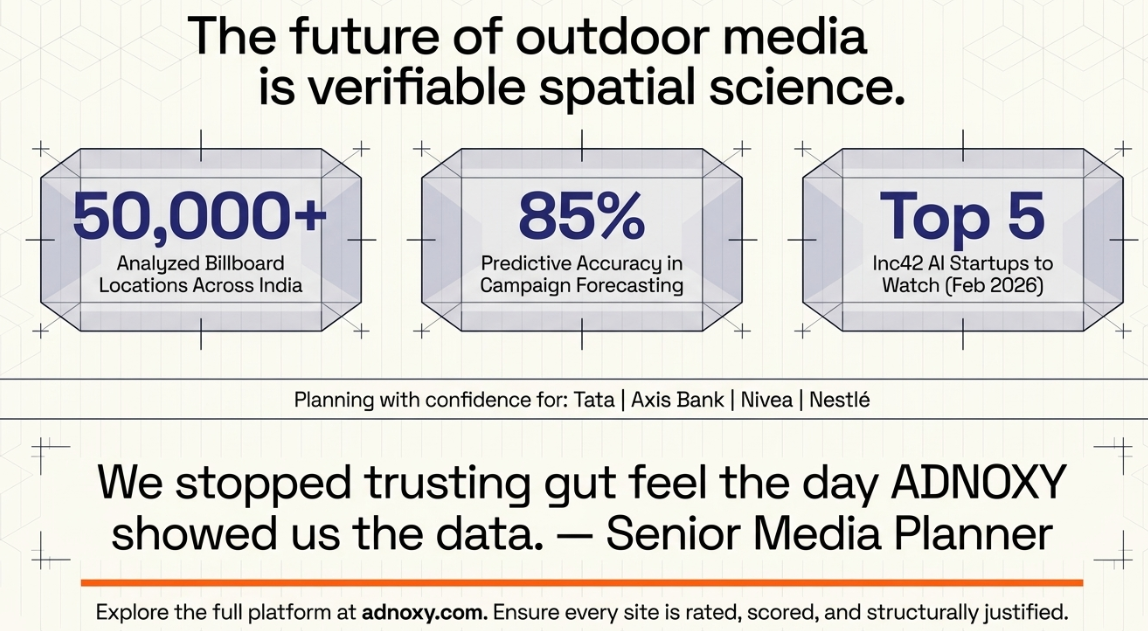
Now featured by Inc42 as one of India's Top 5 AI Startups To Watch in February 2026, ADNOXY has built a spatial library containing over 50,000 analyzed billboard locations across India. The platform delivers an 85% predictive accuracy in campaign performance forecasting, helping blue-chip partners like Tata, Axis Bank, Nivea, and Nestlé plan with confidence. By using proprietary quantum profiling, the platform maps economic quality dynamically across Mumbai, Delhi, Bengaluru, and fifty tier-2 cities. Consequently, brands can move beyond static census data to target high-affluence zones based on live market transaction liquidity.
Here is the part that usually surprises people.
A study by WARC 2026 indicates that combining outdoor campaigns with digital retargeting can lift overall brand recall by another 48%. This structural bridge transforms standard billboards from passive displays into highly efficient customer acquisition channels.
Strategic blueprints for modernizing your outdoor marketing media
To build a highly effective real-world media strategy, your brand must completely stop buying media based on speculative reach metrics. Stop buying reach; your brand does not have a visibility problem, it has a repetition problem, and most outdoor plans actively make it worse by spreading budget across disconnected locations. When you scatter single billboards across a dozen different neighborhoods, you fail to achieve the frequency threshold required to register in a consumer's memory.
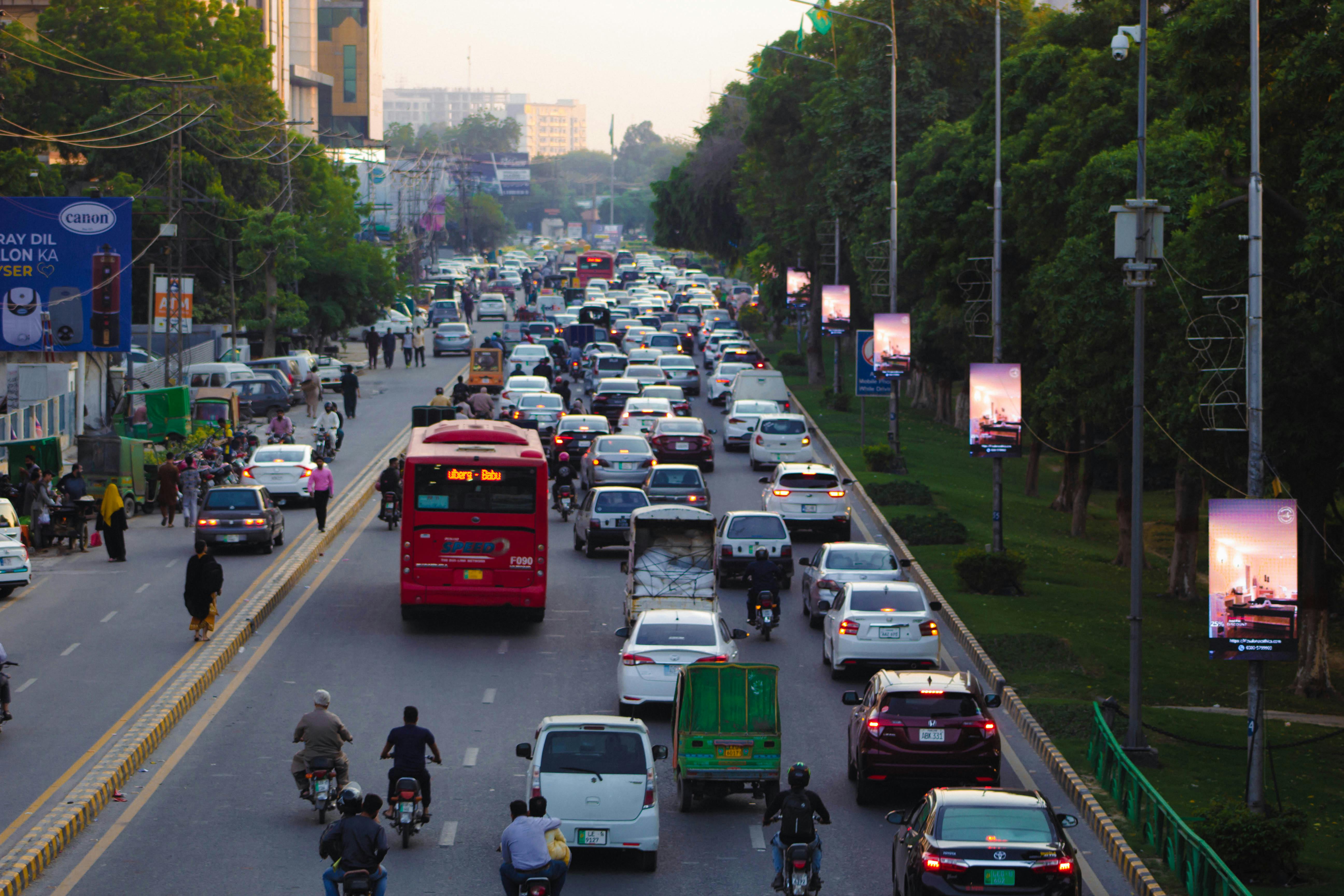
Instead, prioritize what we call transition zones, the specific urban choke points where audiences shift between workspaces, retail clusters, and residential neighborhoods. For instance, the Western Express Highway towards the Bandra-Kurla Complex connector in Mumbai represents a prime transition zone where daily vehicular movement slows down. Such signal-controlled congestion creates a high dwell-time window, giving commuters ample opportunity to process your message. By focusing your investment on these high-attention pockets, you build much stronger brand credibility than you would by dominating high-speed expressways.
Next, adopt a multi-role campaign structure where different assets perform distinct strategic functions. Use a large-format PRIMARY_ANCHOR site at major economic hubs to establish market authority, then surround that zone with COMMUTE_FREQUENCY_DRIVER panels on adjacent arterials to reinforce the message daily.
That is the core failure.
Most brands buy whatever the vendor offers, resulting in disjointed campaigns that lack structural narrative flow. By demanding spatial scoring and a clear role definition for every single site, you confirm your offline marketing works as a cohesive performance system. Our digital management options, including ADNOXY Command, enable you to track these live indicators in real time.
Evaluating your next outdoor advertising intelligence platform
When evaluating a potential outdoor advertising intelligence platform, senior marketing managers must look beyond superficial dashboards to audit the underlying data methodology. I recently watched the marketing head of a major consumer goods brand review campaign proposals for the Chennai OMR IT corridor, where traditional agencies presented slide decks boasting of millions of impressions based on historic traffic censuses. When the brand manager asked how these plans accounted for the varying speed of commuters stuck in Metro Phase II construction bottlenecks, the agencies had no answer.
The turning point came when they ran both plans through an AI OOH platform that evaluated the corridor first. The software revealed that one proposal placed 70% of the budget on high-speed transit segments where ad recall was virtually zero. The second, data-driven plan relocated the budget to specific high-dwell junctions near Sholinganallur and tech parks like TCS Siruseri, where slow-moving traffic facilitated high engagement. This strategic pivot saved the brand thirty percent of their budget while generating a documented 22% increase in store visits within a month.
Such a real-world test proves why you must select a partner that uses a "glass box" methodology. You need to see exactly how traffic speed, viewing angles, and audience affluence are calculated rather than trusting a black box score.
| Media Format |
Typical CPM in INR |
Industry Ad Recall Rate |
Skip or Block Rate |
| Traditional Hoardings |
₹5–₹15 |
82% |
0% |
| Digital Display Ads |
₹50–₹200 |
41% |
65% |
| Social Media Ads |
₹30–₹150 |
38% |
70% |
| Television Commercials |
₹100–₹300 |
62% |
25% |
Your next outdoor media campaign will either be a defensible performance marketing initiative or an expensive exercise in corporate vanity. As Indian cities continue to grow smarter and transit networks expand, relying on handshakes and agency relationships to allocate crores of marketing rupees is no longer just outdated—it is a clear risk to your brand's growth. The future belongs to those who treat real-world spaces as a measurable science, ensuring that every physical site in their plan is rated, scored, and structurally justified before a single brick is laid or flex is printed.
Frequently Asked Questions
How does an AI OOH platform evaluate a city corridor?
Rather than examining a billboard site in isolation, the platform uses a city-first approach to understand how different urban zones connect. By dividing the city into 460-meter hexagonal demand cells, the system models how target demographics move through these spaces. This allows the system to assign strategic value to assets based on the behavior of the corridor they sit on.
What is the difference between a movement score and a raw traffic count?
A raw traffic count simply measures the volume of vehicles passing a site, which can be misleading if traffic is moving too fast. A movement score evaluates dwell conditions, congestion indices, and the frequency of repeat exposure to measure actual attention. This confirms that brands pay for genuine ad recall rather than wasted impressions on a fast-moving highway.
What is the role of brand archetypes in spatial planning?
Different brand archetypes interpret the exact same city data using fundamentally different scoring logic. For instance, a luxury brand archetype prioritizes selective corporate zones and high-street locations to build exclusivity. An FMCG archetype, on the other hand, prioritizes mass transit routes and high-exposure corridors to maximize broad coverage.
Why is there a structural audit gap in traditional outdoor media?
Traditional outdoor media has historically operated on a supply-side model where brands are sold available space with very little verification. Our standard rating system bridges this gap by providing clear, auditable scoring and narrative reasoning for every location before any money moves.
What are transition zones and why do they matter?
Transition zones are specific urban areas where commuter audiences shift between workspaces, retail hubs, and residential neighborhoods. Because traffic naturally moderates and slows down at these points, they generate much longer viewing times for outdoor media. Placing ads in these zones helps build deep, long-term brand credibility by capturing audiences when they are in active decision-making mindsets.
Works cited
1. OOH trends 2026: How the world of OOH Advertising is rewriting the ..., accessed on May 15, 2026, [https://www.socialsamosa.com/guest-post/ooh-trends-2026-ooh-advertising-rewriting-the-rules-11124936](https://www.socialsamosa.com/guest-post/ooh-trends-2026-ooh-advertising-rewriting-the-rules-11124936)
2. India OOH And DOOH Market Size, Share & Forecast Report 2031 \- Mordor Intelligence, accessed on May 15, 2026, [https://www.mordorintelligence.com/industry-reports/india-ooh-and-dooh-market](https://www.mordorintelligence.com/industry-reports/india-ooh-and-dooh-market)
3. OOH Debates Methodology While Advertising Moves On | Billboard Insider™, accessed on May 15, 2026, [https://billboardinsider.com/ooh-debates-methodology-while-advertising-moves-on/](https://billboardinsider.com/ooh-debates-methodology-while-advertising-moves-on/)
4. Real Estate Ads in Chennai \- Key Statistics & Strategies \- AdSpyder, accessed on May 15, 2026, [https://adspyder.io/blog/real-estate-ads-in-chennai/](https://adspyder.io/blog/real-estate-ads-in-chennai/)
5. Rethinking Growth: FOCO, OOH and the ROI lens \- BrandEquity, accessed on May 15, 2026, [https://brandequity.economictimes.indiatimes.com/news/media/rethinking-growth-foco-ooh-and-the-roi-lens/130162973](https://brandequity.economictimes.indiatimes.com/news/media/rethinking-growth-foco-ooh-and-the-roi-lens/130162973)
6. OOH Location Scoring: Algorithms to Evaluate Billboard Location Potential in Indonesia, accessed on May 15, 2026, [https://www.lestariads.com/en/blog/ooh/ooh-location-scoring-algorithms-to-evaluate-billboard-location-potential-in-indonesia.html](https://www.lestariads.com/en/blog/ooh/ooh-location-scoring-algorithms-to-evaluate-billboard-location-potential-in-indonesia.html)
7. OOH Metrics Explained: A Guide to Impressions, Reach, CPM, and More, accessed on May 15, 2026, [https://clearchanneloutdoor.com/blog/ooh-metrics-explained-a-guide-to-impressions-reach-cpm-and-more/](https://clearchanneloutdoor.com/blog/ooh-metrics-explained-a-guide-to-impressions-reach-cpm-and-more/)
8. How should brands be thinking about OOH advertising in 2026? \- Rise, a Quad agency, accessed on May 15, 2026, [https://meetrise.com/insights/how-should-brands-be-thinking-about-ooh-advertising-in-2026](https://meetrise.com/insights/how-should-brands-be-thinking-about-ooh-advertising-in-2026)
9. How to Measure Out-of-Home Advertising Effectiveness (Beyond Impressions) | BlueAlpha, accessed on May 15, 2026, [https://bluealpha.ai/articles/how-to-measure-out-of-home-advertising](https://bluealpha.ai/articles/how-to-measure-out-of-home-advertising)
10. OOH Advertising India – Guide 2026 \- Shubindia Ad Works, accessed on May 15, 2026, [https://www.shubindiaadworks.com/outdoor-advertising-india](https://www.shubindiaadworks.com/outdoor-advertising-india)
11. Outdoor Advertising Cost in India \- Shubindia Ad Works, accessed on May 15, 2026, [https://www.shubindiaadworks.com/outdoor-advertising-cost-india](https://www.shubindiaadworks.com/outdoor-advertising-cost-india)
12. Hoarding Advertising in Dwarka Expressway, Gurugram, accessed on May 15, 2026, [https://acmeadvertiser.com/acme-services/hoarding-in-dwarka-expressway/](https://acmeadvertiser.com/acme-services/hoarding-in-dwarka-expressway/)
13. OOH Advertising Statistics India — 2026 \- Shubindia Ad Works, accessed on May 15, 2026, [https://www.shubindiaadworks.com/outdoor-advertising-statistics-india](https://www.shubindiaadworks.com/outdoor-advertising-statistics-india)
14. Seeking international partners to launch globally. We built the AI ..., accessed on May 15, 2026, [https://www.reddit.com/r/TheFounders/comments/1obhvk7/seeking\_international\_partners\_to\_launch\_globally/](https://www.reddit.com/r/TheFounders/comments/1obhvk7/seeking_international_partners_to_launch_globally/)
15. Billboard marketing in Galleria Market Road gurugram \- Acme Advertising Co., accessed on May 15, 2026, [https://acmeadvertiser.com/acme-services/billboard-marketing-in-galleria-market-road-gurugram/](https://acmeadvertiser.com/acme-services/billboard-marketing-in-galleria-market-road-gurugram/)
16. Predictive Insights for OOH: Smarter Campaigns, Better Results \- dataclair.ai, accessed on May 15, 2026, [https://dataclair.ai/case-study/predictive-Insights-for-ooh-smarter-campaigns-better-results](https://dataclair.ai/case-study/predictive-Insights-for-ooh-smarter-campaigns-better-results)
17. OOH stands tall among traditional media \- Indian Printer & Publisher, accessed on May 15, 2026, [https://indianprinterpublisher.com/blog/2026/04/ooh-traditional-media/](https://indianprinterpublisher.com/blog/2026/04/ooh-traditional-media/)
18. OOH Defies The Slump, Leads Growth In Traditional Media \- Everything Experiential, accessed on May 15, 2026, [https://everythingexperiential.com/article/ooh-defies-the-slump-leads-growth-in-traditional-media-602225](https://everythingexperiential.com/article/ooh-defies-the-slump-leads-growth-in-traditional-media-602225)
19. Billboard Advertising near AIPL Joy Street, Gurugram, accessed on May 15, 2026, [https://acmeadvertiser.com/acme-services/billboard-near-aipl-joy-street/](https://acmeadvertiser.com/acme-services/billboard-near-aipl-joy-street/)
20. Billboard Advertising in BKC Connector, Mumbai, accessed on May 15, 2026, [https://acmeadvertiser.com/acme-services/billboard-in-bkc-connector-mumbai/](https://acmeadvertiser.com/acme-services/billboard-in-bkc-connector-mumbai/)
21. OOH Performance Measurement \- Reveal, accessed on May 15, 2026, [https://revealmobile.com/solutions/measurement](https://revealmobile.com/solutions/measurement)
22. OMR Chennai Real Estate Boom 2026: IT Corridor Drives High-Yield Growth & Investment Opportunities, accessed on May 15, 2026, [https://community.verified.realestate/article/omr-chennai-real-estate-boom-2026-it-corridor-drives-high-yield-growth-investment-opportunities/](https://community.verified.realestate/article/omr-chennai-real-estate-boom-2026-it-corridor-drives-high-yield-growth-investment-opportunities/)
23. Ad Corrector Methodology | Deterministic OOH Ad Testing Without AI, accessed on May 15, 2026, [https://adcorrector.com/methodology](https://adcorrector.com/methodology)