OOH ADVERTISING//September 12, 2025//6 min read
India’s OOH Expansion Needs Intelligence More Than Expansion
India’s OOH market is scaling rapidly, but growth without intelligence risks amplifying complexity instead of value.
India’s OOH market is scaling rapidly, but growth without intelligence risks amplifying complexity instead of value.
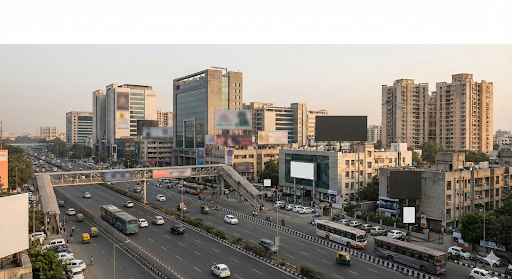
India’s out-of-home advertising market is growing. New billboards line highways, digital screens light up transit hubs, and brands are spending again after years of caution. By most industry measures, this is a success story.
But growth, on its own, is not strategy.
What India is experiencing is not just an expansion of inventory, but an expansion of complexity. More cities. More formats. More owners. More movement. The question is no longer whether OOH can scale. It already has. The real question is whether it can scale intelligently.
Much of India’s recent OOH growth has been driven by structural shifts: infrastructure investment, urban sprawl, rising mobility, and the spread of digital screens beyond metros. These changes have expanded physical presence, but they have not simplified decision-making.
For brands, the OOH landscape is broader and more fragmented. Campaigns that once involved a handful of high-traffic locations now span multiple cities, formats, and contexts. Planning has become harder, not easier.
Yet many decisions are still made the way they were a decade ago—based on familiarity, past experience, and limited visibility into what actually works.
OOH has traditionally been forgiving of imprecision. Its value was assumed rather than proven. That approach worked when campaigns were small, markets were concentrated, and expectations were modest.
Those conditions no longer apply.
As spending increases, scrutiny follows. Marketing teams must justify budgets. Finance teams want confidence, not anecdotes. Leadership wants clarity on where visibility turns into value.
Without better intelligence, expansion introduces risk:
More screens and more sites do not automatically produce better outcomes. They can just as easily amplify inefficiencies.
India’s OOH growth is no longer metro-centric. Tier-2 and Tier-3 cities are now central to brand expansion strategies. Highways, transit corridors, and mixed-use developments command increasing attention.
Planning models built for dense urban cores do not translate cleanly to these environments. Traffic patterns differ. Visibility conditions vary. Consumer behaviour is less predictable. Copy-pasting metro playbooks into non-metro India is increasingly ineffective.
To operate at scale, brands need to understand not just where ads are placed, but how and when they are seen—and by whom.
Digital advertising reset expectations by making performance visible. OOH has not followed the same path, but pressure to do so is growing.
Brands are no longer asking whether OOH works in general terms. They are asking:
These are reasonable questions. They are simply difficult to answer without better systems. The absence of intelligence does not stop spending. It makes spending harder to defend.
Historically, OOH operated on relationships and trust. That trust still matters, but it is no longer sufficient at scale.
As the market expands, decision-making must shift from individual judgment to repeatable systems. From memory to models. From assumption to verification. This does not require OOH to become digital. It requires it to become accountable.
A new class of intelligence-led platforms is emerging to address this gap—introducing forecasting, visibility analysis, and verification into a medium that has long operated without them. Their role is not to replace existing players, but to add clarity where uncertainty was previously accepted.
Expansion is easy. Intelligence is hard.
India will continue to add screens, sites, and formats. That trajectory is unlikely to reverse. But expansion without intelligence eventually hits a ceiling—where more spending yields diminishing confidence.
The next phase of OOH growth will not be decided by who owns the most inventory. It will be decided by who helps brands understand what they are buying. In a market as vast and varied as India, intelligence is no longer a luxury. It is the difference between scaling visibility and scaling value.
And that distinction will matter more with every billboard that goes up.
Naman Sanghi is the CEO of ADNOXY. He is a spatial flow expert and campaign strategist dedicated to establishing neutral, movement-based evaluation standards in physical advertising.