EXPERIENTIAL MARKETING//September 17, 2025//6 min read
The Quiet Return of Experiential Marketing
As digital saturation grows and attention fragments, brands are rediscovering the power of physical presence and lived experience.
As digital saturation grows and attention fragments, brands are rediscovering the power of physical presence and lived experience.
For more than a decade, marketing strategy has been shaped by screens. Budgets followed attention online, and attention seemed limitless. Campaigns could be launched, measured, optimized, and forgotten within weeks. The logic was efficient, and for a long time, it worked.
Now that logic is starting to fray.
Consumers still scroll, but they remember less of what they see. Feeds refresh faster than memory can keep up. Ads appear, disappear, and are replaced before they have time to settle. In this environment, brands are rediscovering something old-fashioned: being physically present.
Experiential marketing, once dismissed as expensive and difficult to scale, is back in serious conversations—not because it is novel, but because it is memorable.
Human memory favors moments over impressions. It retains experiences that involve movement, emotion, and participation. A chance encounter with a brand mascot, a thoughtfully designed pop-up, or a live demonstration does not compete with dozens of messages in the same second. It stands alone.
Online attention is fractional. Offline attention is often undivided.
This does not mean digital marketing has stopped working. It means it has reached diminishing returns. When every brand is optimized for the same platforms, differentiation becomes harder. Experiences, by contrast, are difficult to replicate. They occupy space, interrupt routine, and create stories people tell without being prompted.
Experiential marketing endures because it is social in a way algorithms cannot manufacture. People experience it together. They react in real time. They take photos not because they were asked to, but because they want to remember or share the moment.
These interactions carry credibility. A friend describing an event they attended holds more influence than a sponsored post that resembles every other sponsored post. The recommendation feels earned.
For brands, this exposure cannot be fully controlled. That lack of control is precisely why it works.
Experiential marketing is often misunderstood as spectacle for its own sake—oversized installations, loud activations, short-lived attention.
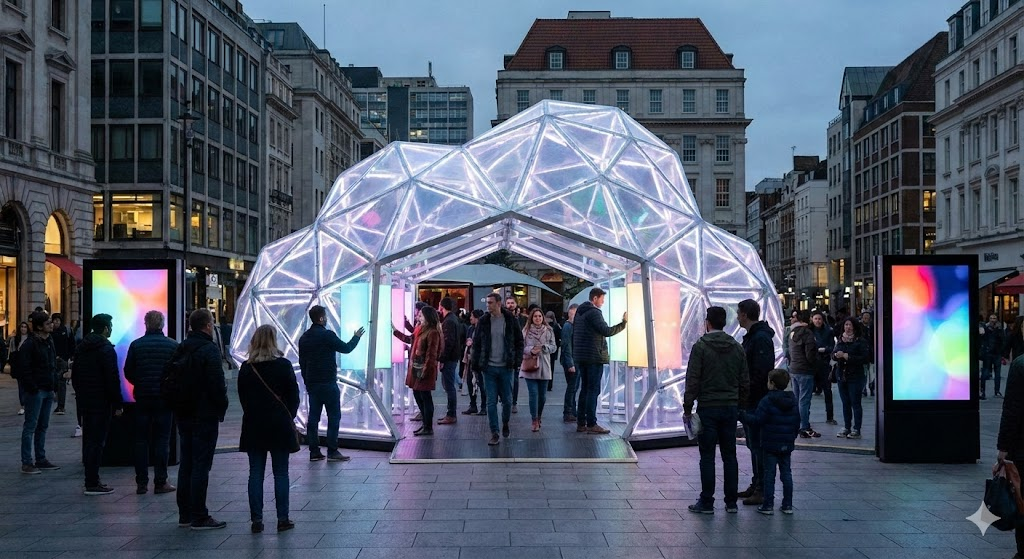
The most effective experiences are quieter. They are designed around relevance rather than scale. A thoughtful in-store workshop. A product trial in a setting where it makes sense. A small event that aligns with how people already live instead of asking them to change their behavior.
What matters is not how many people pass by, but how many walk away with a clear sense of what the brand stands for.
Experiential marketing is not cheap, and it is not easy to measure. That is why many companies hesitate. But the comparison is often flawed.
Digital ads promise efficiency, yet require constant spending to maintain visibility. When budgets pause, presence disappears. Experiences leave residue. They linger in memory. They resurface in conversation. They influence future decisions in ways that are difficult to track but hard to deny.
The return is slower, but often deeper.
The phrase “IRL over URL” may sound like a slogan, but it reflects a real shift. As more of life moves online, physical experiences gain value through scarcity. People crave texture, surprise, and human interaction.
Brands that understand this are not abandoning digital channels. They are rebalancing. The strongest campaigns often begin offline and travel online afterward, carried by people rather than media buys. A moment becomes a post. An event becomes a memory worth sharing.
Experiential marketing does not scale the way digital does. It demands intention. It forces brands to show up physically and be judged in person. That can be uncomfortable.
It is also clarifying.
When consumers remember a brand because of something they experienced rather than something they scrolled past, the relationship changes. It becomes less transactional and more human.
In a crowded digital economy, that may be the most durable advantage a brand can build.
Naman Sanghi is the CEO of ADNOXY. He is a spatial flow expert and campaign strategist dedicated to establishing neutral, movement-based evaluation standards in physical advertising.